
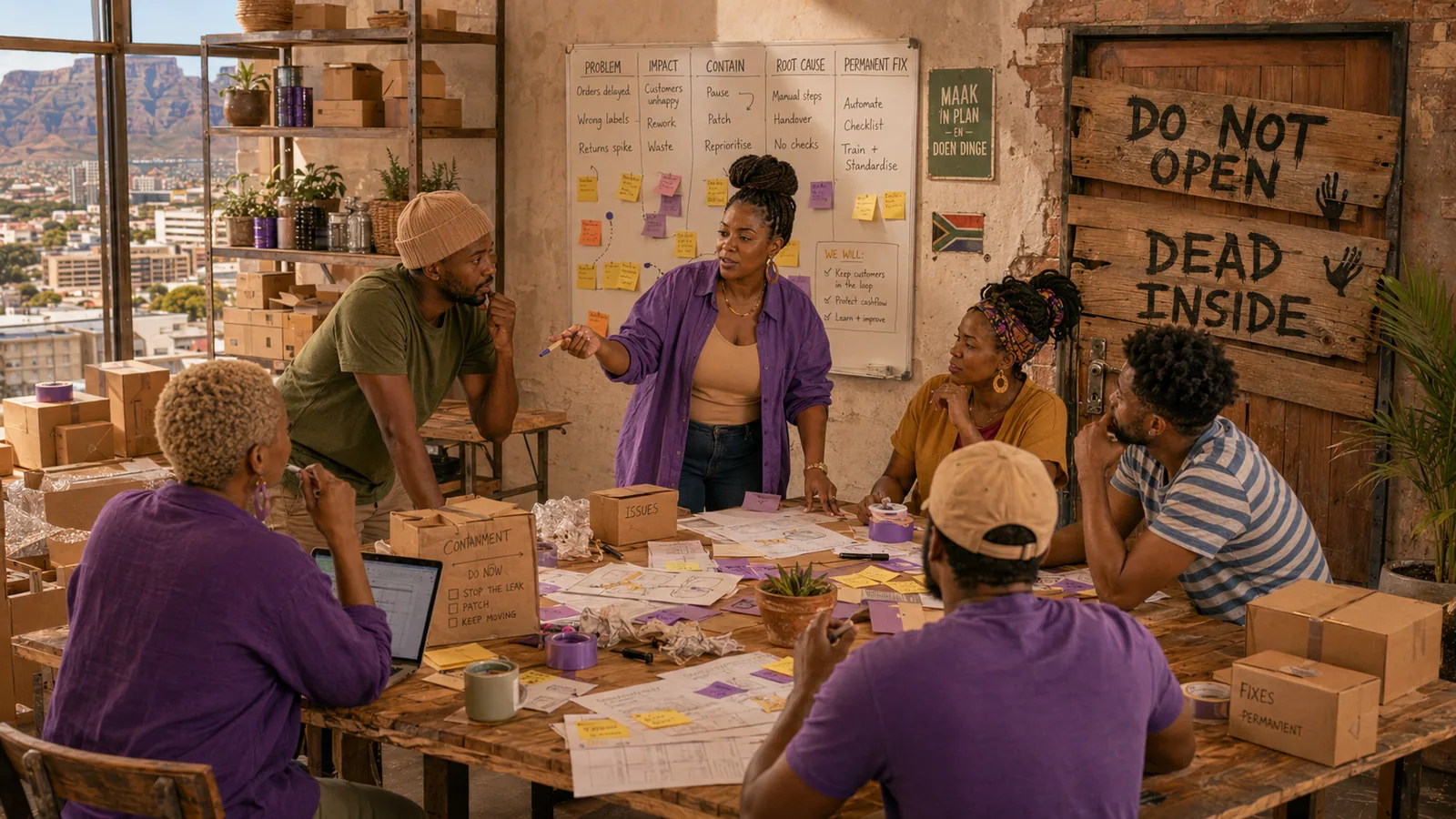
Amazon’s Leadership Principle “Invent and Simplify” gets down to brass tacks when the real act of invention is quietly admitting that something old needs to be taken behind the shed and released from service with dignity.
Not every process deserves a glow-up. Some need a funeral.
This is the part of improvement work that businesses often avoid because stopping something can feel riskier than starting something. Starting has energy. Starting has optimism. Starting gets a meeting invite, a project name and someone saying, “I love the direction.” Stopping is more awkward. Stopping asks why the thing still exists. Stopping asks who it still serves and whether the process is creating value or simply walking around the business eating time.
That is how zombie processes survive.
They are not always as dramatic as a horde in the Walking Dead. They do not arrive groaning through the stockroom with one arm missing and a name badge from 2017. They are usually polite. They sit inside policies, reports and “just in case” habits that once made sense. At some point, they may even have solved a real problem.
Then the business changed. The customer changed. The system changed. The risk changed. But the process stayed.
For South African entrepreneurs, this can happen very easily because small businesses often grow through layers of survival. A step gets added because one customer misunderstood delivery. A check gets added because one supplier disappointed everyone with the confidence of a magician. A manual update gets added because the platform did not do it properly at the time. None of that is foolish. It is adaptation.
The danger begins when nobody goes back to ask whether the step still earns its keep.
A process that once protected the business can quietly become a zombie when nobody checks whether it still creates value.
This is where Invent and Simplify is not only about inventing something new. It is also about retiring the old. Simplification should not just trim the edges. Sometimes it means looking at a process, taking a deep breath and saying, “Thank you for your service, but you are now eating my profits.”
Check whether the work still creates value
The Lean Six Sigma lens for this article is a simple value check. Before improving, scaling or automating a process, ask whether the work still creates value.
Not whether people are used to it or whether it feels safer because it has always been there. Not whether removing it will make someone uncomfortable for ten minutes in a meeting. Does it create value? That is the question with teeth.
A useful value check looks at two sides: customer value and business value. Customer value means the step helps the customer move forward with confidence, from decision to delivery to recovery. Business value means the step protects quality, reduces risk or helps the business scale without turning into a circus tent in a windstorm.
If a process does neither, then it may not be adding value anymore.
This is where sellers need to be honest. Some work genuinely protects the customer. Some protects the business. Some exists because, three years ago, something went wrong and nobody wanted to be blamed twice. That last category is the noise where zombie processes are most often drawn to.
A second delivery confirmation may have made sense when courier updates were unreliable. A manual stock note may have made sense when the business had ten products and one shelf. A weekly report may have made sense when nobody trusted the numbers. But if the underlying conditions have changed, the process should be reviewed. Otherwise, the business keeps paying for old fear with new time and resources it can apply somewhere else.
That is expensive.
And not always in a neat line item. Zombie processes are sneaky like that. They cost attention. They cost speed. They cost patience. They cost customer trust when the journey becomes heavier than it needs to be. They cost team energy because people are feeding steps that no longer feed anything useful back.
This is especially dangerous when a business starts growing. A process that is mildly annoying at ten orders can become poisonous at a hundred. A manual check that felt responsible in the early days can become a bottleneck. A policy written for one unusual case can become a rule that punishes every normal customer after it.
Automation is not forgiveness
The temptation, of course, is to automate it. This is where every improvement person should hear tiny horror music. Because automation can be brilliant when the process deserves to exist. It can save time, reduce errors, create visibility and free people from repetitive work. But automation is not forgiveness. It does not magically turn low-value work into high-value work. It only makes the existing logic move faster.
If you automate a zombie process, congratulations. Now the zombie knows how to open doors.
The better sequence is simple. First ask whether the work should still exist. If yes, ask whether it can be simplified. If yes, ask whether it can be standardised. Only then ask whether it should be automated.
That sequence matters because every automation decision carries a hidden promise. It says, “This work matters enough to build into the way we operate.” If that is true, wonderful. Build carefully. If it is not true, the business has just preserved a bad habit in digital amber.
South African businesses do not need more digital amber. They need useful work, clearly designed.
This is where local businesses actually have an advantage. A large organisation may need months to retire one old process because it touches systems, teams, compliance language and someone’s beloved dashboard. A smaller business can ask the value question faster. Does this step still help the customer? Does it still protect the business? Does it still reduce risk, or does it only reduce someone’s anxiety because it feels familiar?
The point is not to remove every check, policy or manual step because we are feeling spicy on a Tuesday. Some checks matter. Some policies protect the business. Some manual steps are useful because the volume is still low or the risk is still high. The goal is not minimalism for its own sake. The goal is value.
Run a sunset review before the zombie gets a badge
A simple sunset review can begin with one process, policy or workaround that everyone complains about but nobody has questioned properly. Choose something real. A report. A manual check. A duplicated message. Then ask three questions.
Who does this help?
What risk does this protect?
What would happen if we stopped, simplified or replaced it?
Those questions are small enough for a busy seller and sharp enough to make any zombie process reconsider its life choices.
The first question tests customer value. If the step helps the customer make a better decision, avoid confusion or recover from a problem, it may still be useful. The second question tests business value. If the step prevents loss, protects quality or reduces genuine risk, it may still deserve a place. The third question tests whether the process is still the best way to create that value, or whether it has become an old workaround pretending to be policy.
That last part matters. Because sometimes the process should not be killed. It should be redesigned. Sometimes the answer is not “stop doing this.” Sometimes the answer is “do this earlier,” “do this once,” “make this visible,” or “let the system carry it because the human effort is no longer adding judgement.”
That is where Invent and Simplify becomes powerful. It does not rush to delete. It does not rush to automate. It asks what value needs protecting and then invents a better way to protect it.
The question is not only, “Can we do less?” The better question is, “Can we do the valuable part better?” That distinction matters because non-value work is not always obvious. A process can be very well followed and still be the wrong thing to follow.
Customers feel zombie processes as friction. They may not name them. They may not say, “Dear seller, I believe your post-payment confirmation flow contains inherited non-value activity.” They simply experience delay, duplication, confusion or a strange sense that the business is making them jump through hoops for reasons nobody can explain without looking into the middle distance.
Teams feel them too. They feel the rework. They feel the double handling. They feel the moment when someone says, “We have to do it this way,” and nobody can remember why. That sentence should make every process owner sit up like a meerkat.
If nobody knows why the step exists, it is time to check. Not automatically remove. Check.
This is where leadership matters, even in a very small business. Somebody has to give permission to question old work. Somebody has to say, “We are not keeping this just because it has always been here.” Somebody has to protect the team from the guilt of stopping a step that once mattered but no longer earns a place in the process.
Keep it, simplify it, automate it or sunset it
Once that permission exists, the decision becomes cleaner. Then decide. Keep it. Simplify it. Automate it. Or sunset it.
Keep it if it clearly protects customer or business value. Simplify it if the value is real but the effort is too heavy. Automate it only if the step is stable, repeatable and still worth doing. Sunset it if the value no longer justifies the time, delay or complexity.
Those four options are important because sunset does not mean chaos. It means intentional retirement. It means the business has decided that a step no longer creates enough value to justify the effort, delay or complexity it adds. Done properly, sunsetting is not neglect. It is process hygiene.
And let us be honest, some processes need hygiene. Invent and Simplify gives sellers permission to stop feeding the zombies. The next level is knowing which plans still deserve to stay. That is how local grit becomes operating discipline. Not by keeping every survival tactic forever, but by turning the useful ones into standards and retiring the ones that have done their time.
So before you automate the report, question the report. Before you train the team on the extra check, question the check. Before you build a dashboard for the workaround, question the workaround.
Ask whether the work creates customer value. Ask whether it creates business value. Ask whether it should exist in this form at all.
Because if the answer is no, the brave move may not be to improve it. The brave move may be to stop.
A zombie process does not need a dashboard. It needs a sunset.
This is a personal thought piece, written from my own customer experience and process improvement perspective. It draws on publicly available information and reflects my own views.