
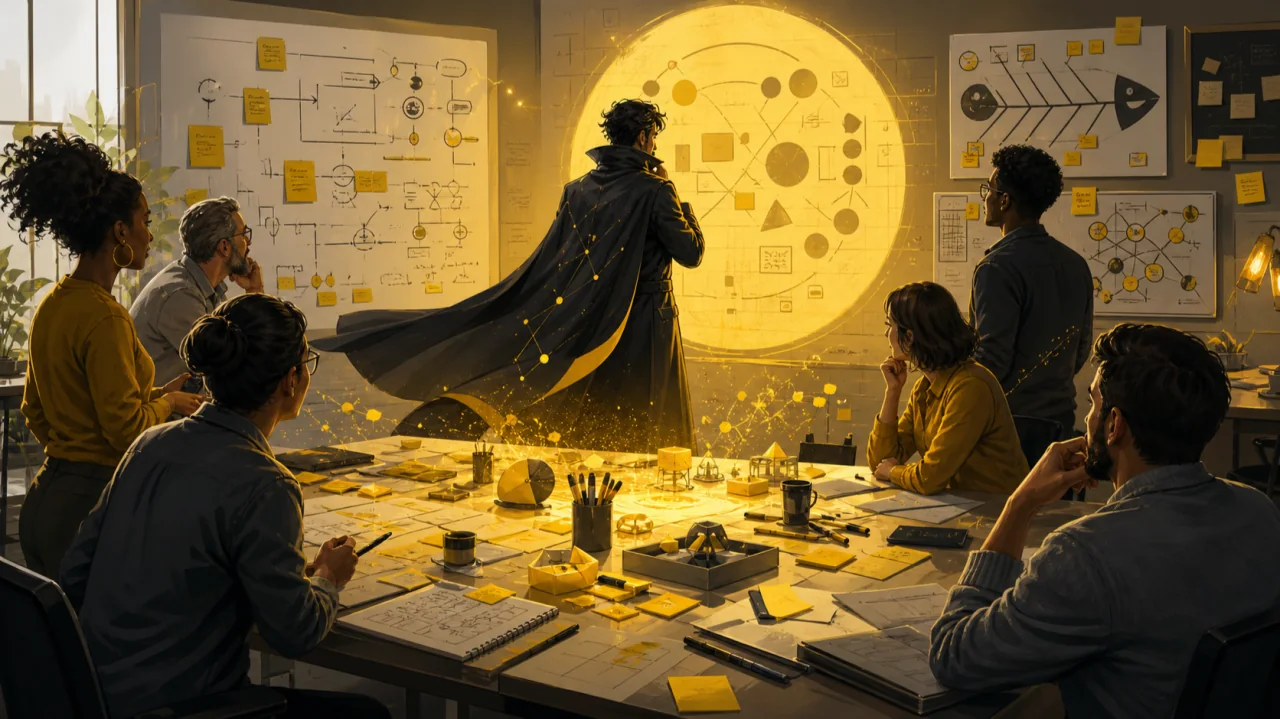
Play Is Not a Break From Work. It Is Where Better Thinking Begins
Use this field note when an improvement room has become so disciplined that curiosity has been escorted out by security, clipboard first.
Have you ever walked into a Kaizen session, a Gemba walk, a Working Backwards review, or any room where improvement is supposedly on the table, and felt the room tighten before anything meaningful had even been said?
Not because anything was wrong. Everything was professional. Structured. Disciplined. Exactly as it should be. Laptops opened with ceremonial importance. Someone adjusted the process map as if it were a witness under cross-examination. The room settled into its serious face. Thoughts became polished. Conversations became careful. People started speaking in conclusions rather than curiosities.
And in that shift, something else quietly stepped out of the room. Not capability. Not effort. Not intelligence. Something softer. Something far more useful than we tend to admit. The willingness to wander before deciding.
We keep asking people for better ideas inside environments that have quietly trained them to stop playing with possibilities. Then we look around, slightly baffled, and wonder why the thinking feels so familiar.
The Serious Little Trap We Set for Ourselves
Let us be clear before the process police arrive with a clipboard. This is not an argument against rigour. Rigour matters. Discipline matters. Structure matters. A good method gives thinking shape. It helps an idea survive contact with reality instead of dissolving into inspirational fog and suspiciously enthusiastic stationery. But structure applied too early can also become a cage.
That is where many improvement environments start to wobble. Six Sigma, Lean, Kaizen, Gemba, Working Backwards, root cause analysis, and all the clever cousins in the process family were never meant to be corporate theatre. They were meant to help us see more clearly. They were meant to slow down assumptions, sharpen observation, expose friction, and make the invisible visible. Yet somewhere along the way, the tools themselves became performances of credibility.
DMAIC moves quickly. Root cause discussions land neatly. Gemba walks feel composed, almost rehearsed. Working Backwards documents look beautifully customer-obsessed, even when the answer has been quietly pre-selected and everyone is simply reverse-engineering the justification with excellent grammar.
Everything looks controlled. Everything looks credible. The system, on the surface, feels fine. But if you sit in enough of these rooms, a pattern emerges. The answers often arrive very quickly. Almost too quickly. And quick answers are not always a sign of clarity. Sometimes they are a sign that the room has entered closed mode far too early and politely locked the door behind it.
Closed Mode Wears a Suit. Open Mode Arrives Without an Agenda
Closed mode is not the villain. It is necessary. It executes. It decides. It lands the plane. It turns thought into delivery. Without closed mode, organisations would become philosophical soup with calendar invites. But closed mode can only operate on what has already been accepted as true.
Open mode is different. Open mode is slower. Less certain. Slightly awkward in fluorescent lighting. It asks questions before it offers answers. It allows the problem to expand before it is defined. It lets odd connections surface before the room starts trimming them into something respectable. And here is the tension.
Most organisations are structurally designed to reward closed mode and quietly question open mode. Closed mode leaves evidence. It eaves possibility. Produces actions. Open mode produces better questions. Closed mode looks productive. Open mode often looks like someone staring out of a window, which is apparently only acceptable if you are a poet, a cat, or a very expensive strategist. So we get very good at executing what we already understand, and less practised at discovering what we do not.
The Part Where We Accidentally Skip the Interesting Bit
Play is not what happens after the serious work is done. It is the condition that makes original thinking possible.
I am pointing a finger at a moment in every meaningful improvement conversation that rarely gets protected. It sits just before the conclusion. The data is present, but not yet complete. Something does not quite fit. Someone senses a gap. A thought begins to form, not fully shaped, not yet ready to stand on its own. It is the tiny wobble in the room. The place where the obvious answer starts to look slightly too obedient.
This is where open mode lives. And this is where we often move on. Not because anyone intends to miss it. But because that moment does not look like progress. It cannot be easily captured. It does not translate into a clean next step. It is difficult to write, “We allowed the discomfort to breathe for three minutes and something interesting nearly happened,” in a project update.
So we step past it. And in doing so, we often step past the very thing that might have changed the direction entirely. Because if the system only recognises finished thinking, unfinished thinking does not survive long enough to become useful.
The Fishbone Diagram Was Innocent, Your Assumption Was Not
Imagine a root cause session where a team is reviewing a recurring customer issue. The first explanation arrives quickly: the customer did not follow the process. Everyone nods. It sounds reasonable. The process exists. The instruction was there. The customer missed it. Case almost closed.
The improvement becomes predictable. Make the instruction clearer. Add another reminder. Update the wording. Send the communication again, but this time with more bold text, because apparently customers respond well to typographical shouting. But the more interesting question is sitting quietly in the corner wearing a suspicious hat. Why did the process make sense to us and not to them?
That question changes the room. It moves the conversation away from customer failure and towards design responsibility. It invites curiosity instead of blame. It turns the process from something to defend into something to examine.
That is play. Not beanbags. Not balloons. Not someone forcing adults to build a tower out of spaghetti while pretending this has transformed the culture. Play, in this context, is the willingness to move the pieces around differently before deciding where they belong.
Boredom, That Dangerous Little Luxury We Eliminated
There was a time when doing nothing for a few minutes did not need justification. Now it feels like a gap that must be filled before productivity catches us loitering. Every pause gets occupied. Every quiet moment replaced with input. A notification. A meeting. A dashboard. A message beginning with “quick question,” which history has shown is rarely quick and often spiritually expensive. It all looks efficient. It keeps everything moving. It gives the system something to measure. But something subtle gets engineered out in the process.
When there is no external input, the mind starts generating its own. It wanders. It connects. It revisits problems without being asked to solve them immediately. It returns to an unresolved conversation and suddenly notices the missing piece. It takes two ideas from different rooms and introduces them to each other over coffee in the back of the brain.
That is open mode again. Quiet. Unstructured. Difficult to measure. So it disappears. And then we ask for originality. The calendar is full. The activity is visible. The system feels productive. But the conditions that produce original thinking have quietly been removed.
Incubation Is Not Lazy. It Is Just Difficult to Put in a Dashboard
Some of the most important thinking does not look like work at all. It looks like stepping away. Returning later. Sleeping on something. Walking around with a half-formed question rattling in the mind like a marble in a tin. It looks like something shifting quietly in the background until the answer feels different, even if you cannot fully explain when the shift happened.
From the outside, it is deeply unsatisfying. There is no visible effort. No measurable activity. No clear evidence that anything was happening at all. And this is where another pattern shows up. What we cannot measure, we start to distrust. So we compress it. Replace it. Speed it up. We favour thinking that leaves a trail over thinking that creates a shift. And in doing so, we trade depth for visibility. Not because we intend to. Because the system rewards what it can see.
Collaboration, or How to Be Very Aligned and Slightly Unchanged
In group settings, another little theatre tends to unfold. Alignment arrives quickly. Smoothly. Respectfully. Everyone nods. Someone captures the decision. The room feels relieved. Progress has been made. Sometimes what we call alignment is just the earliest point at which the room became comfortable.
The tension that sits beneath disagreement is often where better thinking begins. Not conflict for the sake of it. Not ego with a parking permit. But the kind of difference that forces the room to stay open a little longer. When that tension disappears too early, so does the opportunity to explore something different. What remains is something everyone can agree on. Which is not always the same as something worth pursuing.
This is where leadership matters. Not as the person who forces the answer, but as the person who protects the process long enough for the answer to improve. Sometimes the most useful thing a leader can do in an improvement room is not to speak first, solve first, or align first. It is to stop the room from tidying away the thing that does not yet make sense.
How to Reintroduce Play Without Making HR Design a Mandatory Fun Poster
Bringing play back into serious work does not require a dramatic announcement. In fact, please do not announce it. The moment we create a programme called “Playful Innovation Enablement,” the whole thing may collapse under the weight of its own laminated enthusiasm.
It starts smaller than that. It begins with allowing a thought to remain unfinished for a moment longer. Letting a question sit without rushing to resolve it. Following a line of thinking even if it does not yet have a clear destination. Asking, not “What is the root cause?” quite so quickly, but “What are we assuming is not the cause?” Asking, not “How do we align?” but “What difference in the room should we stay with for one more minute?” Asking, not “What is the action item?” but “What did we notice that does not fit the story yet?”
At first, it feels unfamiliar. Slightly slower. Slightly exposed. Almost like an adult remembering how to play a game they have not touched in years. Careful at first. Self-conscious. Aware of the rules. Aware of who is watching. Testing the edges before committing.
Then something shifts. Someone offers an unfinished thought and laughs nervously. The manager does not tidy it up. No one gets punished for thinking oddly. Another person builds on it. A third person notices a pattern that had been hiding in plain sight. And eventually someone says the line that changes the room: “Wait, what if we have been solving the wrong problem?”
That is the moment. Not chaos. Not silliness. Not lack of discipline. The work starts to flow because the thinking was allowed to open before it was asked to close.
From Compliance to Curiosity, Without Losing the Plot
None of this removes the need for structure. The rigour still matters. The discipline still matters. The tools still matter. But they were never meant to operate alone. Six Sigma without curiosity becomes compliance. Curiosity without structure becomes noise. The balance is where the real work lives. The danger is not that Six Sigma becomes too structured. The danger is that it becomes so structured that the thinking defects inside the room go undetected. And those defects are expensive.
They show up as solutions to the wrong problem. As process improvements that make the dashboard happier but the customer no less confused. As Working Backwards documents that begin with the customer but end exactly where the organisation already wanted to go. As Gemba walks where everyone observes the work except the assumptions they brought with them.
That is not a failure of the tools. It is a failure of the conditions around the tools.
The Game We Forgot We Were Playing
Being a gamer in all forms I have recognized the pattern in how people approach any game. At the beginning, they are careful. Learning the rules. Slightly reserved. Testing the edges. Watching how others move. Then, as the boundaries become familiar, something shifts. They stop performing and start participating. Time moves differently. Decisions feel less forced. The experience becomes immersive. They are still inside rules, but the rules no longer make them rigid. The rules make play possible.
That same transition is available in work. But only if the room allows people to move through the careful stage into the creative one. Too often, we interrupt that transition. We demand performance before participation has had time to wake up. We ask for innovation before trust has entered the room. We want flow, but we do not protect the conditions that create it.
And then we blame people for being unimaginative. How convenient.
A Different Way to Walk Into the Room
So the next time you walk into a Kaizen, a Gemba, a Working Backwards session, or any room where improvement is supposedly on the table, try something small. Before you rush the room into certainty, protect one unfinished thought. Let the odd question live for a minute. Follow the thing that does not quite fit. Because play is not what happens after the serious work is done. It is not the reward for productivity, the soft bit at the end, or the decorative sprinkle on the corporate cupcake.
Play is the condition that makes original thinking possible. So try it. Not loudly. Not theatrically. Just enough to keep the room open before it closes. And then ask yourself honestly: did the room lose discipline, or did it finally start thinking?
This is a personal thought piece, written in my private capacity from my own customer experience and process improvement perspective. It draws on publicly available information and reflects my own views, not the views of my employer. It does not discuss or rely on confidential company information.