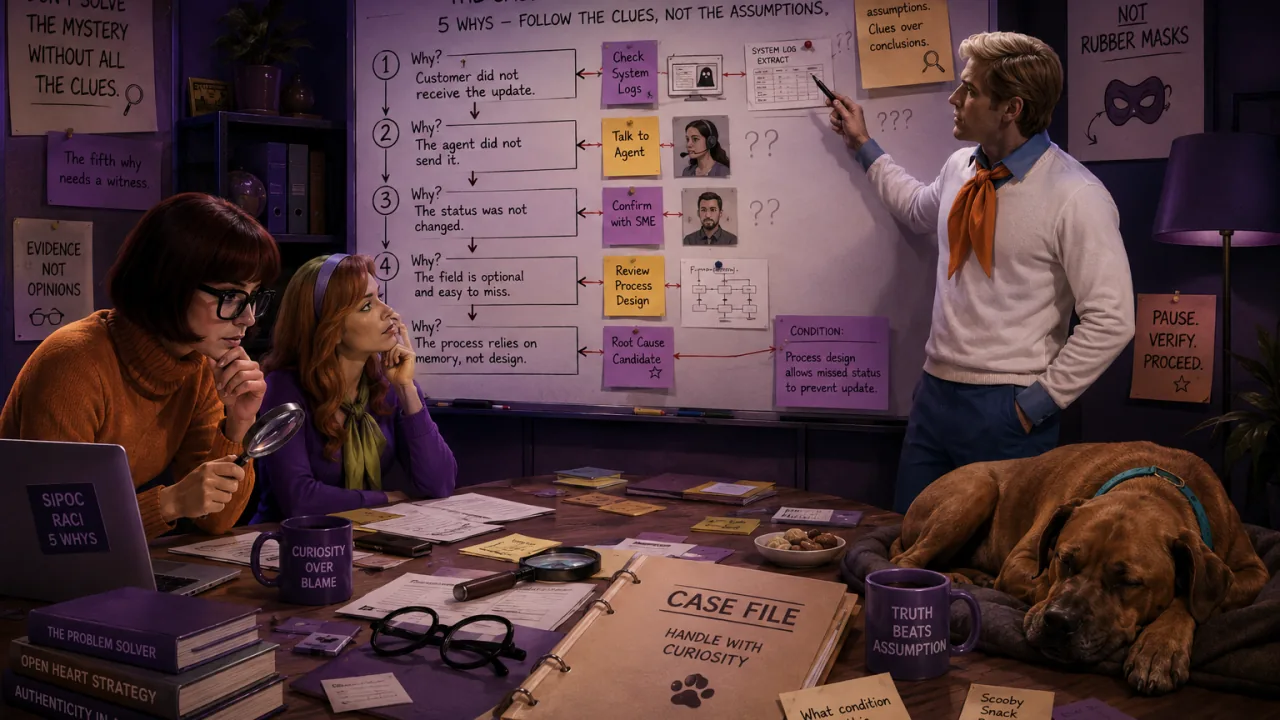
They Mystery machine has left the workshop and somewhere along the way, 5 Whys got locked inside the facilitated improvement session. It became something we pull out during a Kaizen, a Green Belt project, a structured problem-solving workshop, or one of those rooms where someone has thoughtfully provided sticky notes, markers, and the faint smell of corporate seriousness. The team gathers. The facilitator explains the tool. The problem is written at the top. The group asks why, then why again, and everyone politely hopes root cause will appear before the meeting ends and the biscuits vanish.
That version has its place. A facilitated group session can be incredibly useful, especially when the right people are present and the facts are available. But I do wonder whether we have accidentally made the tool smaller by only imagining it in that setting. We treat 5 Whys as if it must be completed in one sitting, by one group, in one room, on one neat ladder, otherwise the exercise has failed. That is a very tidy idea. It is also not how real work behaves.
Real problems are rarely polite enough to sit still for a workshop. An escalation may start in Customer Service, cross into Operations, bump into Tech, collect a policy question, disturb Finance, and then quietly reveal that the real issue began three handoffs earlier with an input nobody had properly defined. One why may belong to the frontline. The next may belong to a system owner. The third may need a data pull. The fourth may need someone who remembers why a workaround was created two years ago. The fifth may be hiding in a decision made by a team that was never invited to the original discussion.
So perhaps the question is not whether we know how to ask why. Perhaps the question is whether we have been brave enough to let the ladder move.
Scooby-Doo, But Make It Root Cause
I keep thinking of the Scooby-Doo gang for this one. Not because problem-solving should be childish, but because the structure is oddly perfect. There is always a mystery. There is always a visible problem. There is always an obvious suspect, usually lurking near the smoke machine with terrible posture. The gang arrives in the Mystery Machine, looks around, gathers clues, speaks to witnesses, follows footprints, opens the wrong cupboard, screams dramatically, regroups, and only then starts to understand what is really going on.
That is what 5 Whys should feel like when it is used well. Not a courtroom confession. Not a forced march to the nearest human error. Not a neat little performance where the team asks why five times and then pretends the person closest to the incident was the villain all along. It should feel like following clues with enough humility to admit that the first explanation may be wearing a rubber mask.
The visible issue is rarely the whole story. The customer did not receive the update. The case missed the deadline. The handoff failed. The metric went red. The dashboard started blinking like it had seen a ghost. Those are the spooky noises in the hallway. They matter, but they are not yet root cause. If the gang ran home after the first creaking door, there would be no episode. If a team stops after the first plausible answer, there is usually no improvement either.
The Slow Ladder
The most important thing about 5 Whys is also the thing we do not say often enough: it does not have to happen in one sitting. The ladder can be slow. It can be paused. It can cross functions. It can move through an email thread if that is what the work needs. It can begin in a meeting, stop at the edge of the room’s knowledge, continue after an SME weighs in, and then return to the original chain with better evidence.
That is not a broken 5 Whys. That is a mature one.
The tool breaks when we force completion without truth. It breaks when the room reaches the second or third why, realises it does not have the right person or data, and then invents the next answer because the template has empty boxes. A tidy why chain is not the same as an accurate one. Some of the most dangerous root causes in corporate life are the ones that sound sensible enough to survive a meeting.
A slow ladder gives the team permission to pause without losing momentum. It says, “We can answer this first why from what we know. The second answer needs validation. The third belongs to another function. The fourth requires a system log. The fifth cannot be written until we know whether the input was complete when it entered the process.” That is not hesitation. That is discipline.
Root cause does not care about the calendar invite. The problem will not become truer because everyone wanted to finish before lunch.
The Fifth Why Needs a Witness
Every why needs a witness. That witness may be a person, a system record, a process map, a customer verbatim, a timeline, a policy document, a data pull, or a repeated pattern seen by the people closest to the work. If nobody can validate the answer, then it is not yet a finding. It is an assumption with nice handwriting.
5 Whys can produce very convincing nonsense when people are under pressure to sound decisive. The chain may look logical. The final answer may feel familiar. Everyone may nod because the conclusion fits the story they already half-believed. But a why chain built on untested assumptions is not root cause analysis. It is fan fiction with a flip chart.
Consider the classic lazy route. The customer did not receive the update. Why? The agent did not send it. Why? The agent forgot. Why? They were not paying attention. Why? They need refresher training. Suddenly the nearest human has been unmasked, the training action has been logged, and the organisation gets to feel as though something has been done.
But what if the update depended on a manual status change? What if the status field was optional? What if the system did not make it clear that the status triggered a customer notification? What if the case type was ambiguous? What if the upstream team supplied incomplete information? What if the process relied on memory instead of design?
Now the story changes. The villain was not the agent in a rubber mask. The real culprit may be a process that quietly allowed missing information to travel downstream until the customer felt it.
Do Not Split Up Yet
Every Scooby-Doo episode contains one deeply questionable operational decision: “Let us split up.” It is iconic. It is dramatic. It is also the reason someone always ends up trapped in a cupboard with a ghost who has suspiciously human shoes.
Problem-solving does the same thing when teams rush into separate theories before they understand the map. Operations has one explanation. Tech has another. Policy thinks it is a training issue. Training suspects the SOP. The frontline says the customer journey has been screaming about this for months. Leadership asks whether we can just add a tracker. Before long, everyone is running down a different corridor while the actual cause sits quietly behind a rotating bookcase, eating a sandwich.
This is why the previous tools in the series matter. RACI helps clarify who belongs in the work and what role they play. SIPOC helps clarify what process we are actually examining. 5 Whys then helps us follow the trail inside that frame. If the frame is wrong, the why chain may point beautifully in the wrong direction.
The gang needs the right people in the van. Not only the senior people. Not only the available people. Not only the people with the loudest opinions. The right people. The SME who understands the system behaviour. The frontline person who sees where the customer gets stuck. The process owner who knows the intended flow. The upstream team that supplies the input. The downstream team that inherits the output. The analyst who can check whether the story matches the data. Without them, the why chain may still sound clever, but it will be built from partial context.
Let the Ladder Travel
One of the most useful shifts is to stop treating 5 Whys as an event and start treating it as a way of thinking. It should not be reserved only for formal improvement activity. It can become part of how we handle escalations, recurring issues, quality misses, customer friction, process drift, and those small operational gremlins that everyone knows about but nobody has properly named.
In an escalation, the first why might be asked in the initial thread. The next answer may come from an action owner. A third may require a quick follow-up with the system team. A fourth may need a screenshot, a transaction log, or a customer timeline. The chain can continue asynchronously, as long as the facilitator keeps the structure clean and separates evidence from assumption.
This does not mean turning every email into a philosophical pilgrimage. Nobody needs a forty-reply chain titled “Why, though?” with half the village copied in. The point is not to create more noise. The point is to make inquiry more disciplined. A good escalation owner can use 5 Whys quietly in the background, almost as a thinking scaffold, to stop the team from accepting the first explanation that wanders past wearing a hat.
It can be as simple as saying, “We think the missed update happened because the status was not changed. Can the system owner confirm whether that status triggers the notification, and can the frontline confirm whether that step is visible in the current workflow?” That is 5 Whys breathing in real life. Not ceremony. Not theatre. Just better thinking.
Human Error Is Not the Monster
Human error is often where bad 5 Whys goes to sleep. It sounds final. It sounds accountable. It gives the room a person-shaped answer and a familiar solution. Coach the person. Retrain the team. Send a reminder. Add a note. Close the action. Then, three weeks later, the same issue comes creeping back through the hallway with glowing eyes and a suspiciously familiar laugh.
Human error may be part of the story, but it should rarely be the last page. If someone forgot, ask what made forgetting possible. If someone missed a step, ask why the step was easy to miss. If the team did not follow the process, ask whether the process was clear, usable, visible, realistic, and designed for the conditions people actually work in. If nobody caught the issue, ask where detection was meant to happen and why that control did not work.
This is not about removing responsibility from people. It is about refusing to confuse accountability with convenience. The person closest to the smoke is not automatically the fire. Sometimes they are the one who noticed the fire first. Sometimes they are the one who has been breathing it in for months while the rest of the organisation admired the dashboard.
A good 5 Whys does not ask, “Who can we pin this on?” It asks, “What condition made this failure possible?” That question changes the room. It moves the conversation from accusation to design.
Velma Energy Is Not Optional
Every good 5 Whys needs Velma energy. Someone has to pause the drama and ask, “What do we actually know?” It is not the most glamorous role. It will not get the cinematic chase scene. But it is the role that keeps the gang from blaming the glowing ghost before checking who owns the projector.
Velma energy separates facts from assumptions. It asks who can confirm the answer. It checks whether the data supports the story. It notices when the team has blended three different issues into one suspicious smoothie. It asks whether the why chain still explains the original problem or whether everyone has wandered into a neighbouring swamp because it felt productive.
It also knows when the room is getting tired. That matters more than we admit. Teams often stop at the first answer that gives them something to do. Training is attractive because it is familiar and polite. A reminder is easy. A tracker looks responsible. A new check feels reassuring. None of these are wrong by default, but they should not be allowed to masquerade as root cause simply because the room ran out of patience.
Training may be necessary. Coaching may be helpful. A reminder may reduce risk for a while. But if the process still allows the same defect to happen tomorrow, the team has not solved root cause. It has thrown a Scooby Snack at a structural problem.
Some Mysteries Have More Than One Corridor
5 Whys is often drawn as one clean vertical chain. Problem, why, why, why, why, why, root cause. Lovely. Efficient. Very neat on a slide.
Real work is often more like a haunted mansion.
One corridor leads to input quality. Another reveals unclear ownership. A third points to system design. A fourth exposes policy ambiguity. Somewhere behind a rotating bookcase, there is a workload issue wearing a cape. This does not mean the team failed. It means the issue may have more than one cause path.
Forcing a complex problem into one tidy chain can flatten the truth. Sometimes you need more than one why path. Sometimes a fishbone diagram helps before you choose the branch worth investigating. Sometimes a timeline reveals that the issue did not begin where the team thought it did. Sometimes the SIPOC needs revisiting because the process boundary was drawn too narrowly.
The point is not to make 5 Whys heavier than it needs to be. The point is to keep it honest. Some problems really are simple. Some are not. The discipline lies in knowing the difference.
A Field Guide for the Mystery Machine
If we take 5 Whys out of the workshop and make it part of how we think, then the rules become very practical. Start with a clear current condition, not a vague emotional fog. Make sure the process frame is understood. Bring in the people who know the work, even if they enter the conversation later. Ask each why against the previous answer, not against the general irritation in the room. Mark assumptions clearly. Pause when the evidence is missing. Let the chain branch when the issue has more than one cause path. Do not stop at human error without asking what made the error possible. Keep checking whether the answer still explains the original problem.
Most importantly, allow the ladder to wait.
That may be the most mature move in the entire process. Not abandoning the question. Not losing momentum. Not creating an endless investigation with no decisions. Simply recognising when the next answer requires a witness, a log, a process owner, or a piece of evidence that is not currently in the room.
There is dignity in saying, “We do not know yet.” There is intelligence in saying, “We need to validate that.” There is leadership in saying, “Let us not close this chain on a guess.”
Why Is a Flashlight, Not a Hammer
5 Whys is not weak because it is simple. It becomes weak when we use it as a one-meeting ritual, a blame funnel, or a guessing game. Used badly, it turns into a workplace interrogation where everyone watches the nearest human get unmasked. Used well, it becomes a flashlight.
It helps the team move through the dark carefully, clue by clue, stopping when the beam runs out and returning when someone has found another battery. It can live in a Kaizen session, yes. But it can also live inside an escalation, a quality review, a recurring defect discussion, a customer pain point, or the quiet operating system of a person who refuses to accept the first easy answer.
The next time someone says, “Let us just do a quick 5 Whys,” perhaps the answer is: yes, let us start. But let us not pretend we have to finish before the room knows enough to be honest.
Because the fifth why is not a confession.
It is a clue.
And sometimes the best problem-solver in the room is the one brave enough to say, “Gang, we need to get back in the van. We have one more witness to find.”