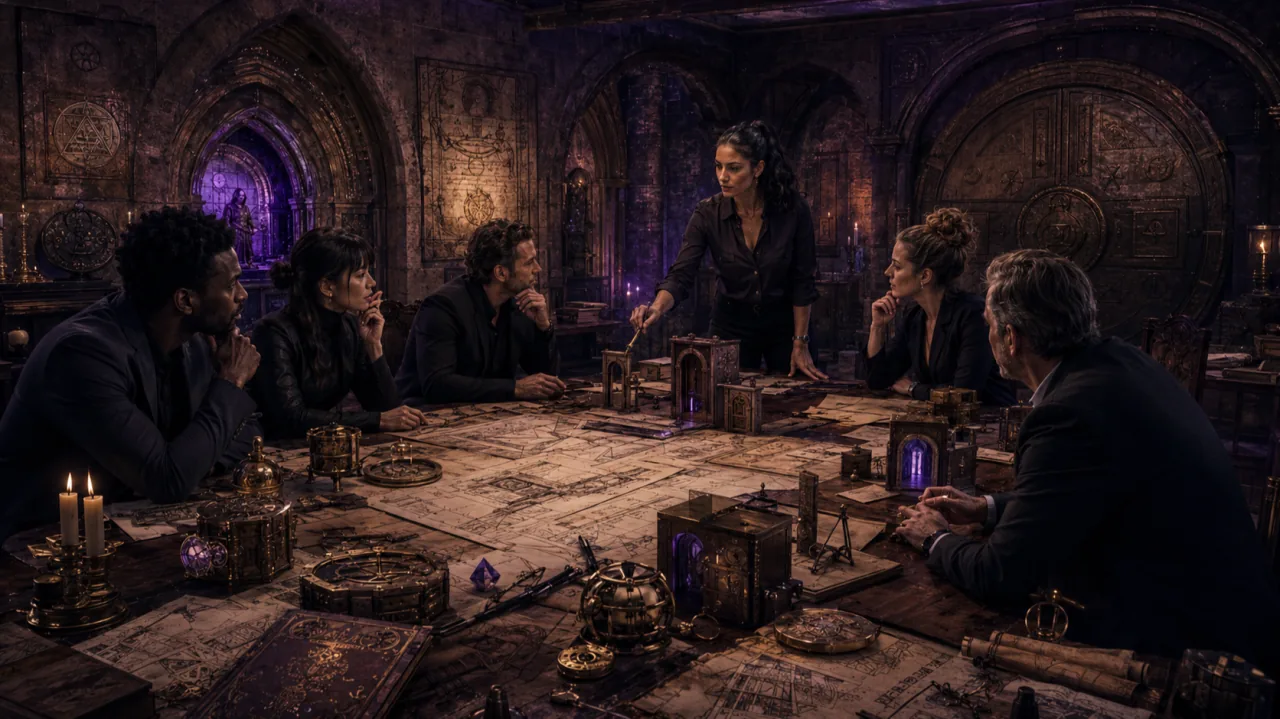
I love a mystery that makes you follow the clue instead of simply find the answer. Give me a Robert Langdon-style chase through an old city, and I am in. The churches, the libraries, the stone courtyards, the rose lines, the carved symbols, the rooms that smell faintly of dust and conspiracy. Somewhere beneath all of it, there is a secret chamber waiting to be found.
Not by everyone. Not by accident. Not by the loudest person with a torch and too much confidence.
The chamber was never meant to open for the careless traveller, the impatient intruder, or the person who skipped the clue because the deadline was making dramatic eye contact.
That is the part I find fascinating. Not only the chase. Not only the puzzle. The design.
Someone built the path before the hero ever arrived. Someone decided which clue should appear first, which door should stay closed, which symbol should matter, which false route should fail, and which sequence would protect the thing at the centre. The real genius belongs to the person who sat down long before the chase began and thought through the route with care.
They chose the symbols. They carved the inscriptions. They hid the clue where it would be seen by the right eyes and missed by the wrong ones. They built the mechanism so that one missing step would prevent the final door from opening. They understood that the secret was too important to leave lying around for anyone with a crowbar, a bad map, and unreasonable confidence.
That, in a strange and wonderfully nerdy way, is Poka-Yoke.
Poka-Yoke is usually translated as mistake-proofing or error-proofing. In practice, it is the art of designing the work so that the right action is easier, the wrong action is harder, the defect becomes visible early, and recovery is possible before the customer pays the price. It is not merely a factory trick involving switches, plugs, warning lights, and jigs. It is a way of thinking. A way of designing. A way of saying that the process should not need a hero standing at the end, catching every mistake with a cape and a spreadsheet.
The master builder does not wait at the final chamber with a clipboard. They design the corridor so the wrong door does not open.
That is the power of Poka-Yoke. It moves quality upstream. It builds intelligence into the path. It asks us to rely less on memory, vigilance, heroics, last-minute inspection, and the exhausted goodwill of people who are already carrying too much. Instead, it asks us to design the route with care, so that failure has fewer places to hide.
Mistake-Proofing Is Not Babysitting
There is a danger with the phrase mistake-proofing. It can sound patronising, as if the process designer is standing over everyone with a whistle, assuming people are careless little gremlins who cannot be trusted near a form field. That is not the spirit of the tool at all.
Poka-Yoke is not about distrusting people. It is about respecting reality. A good process does not demand fantasy employees. It protects real ones.
Real people get tired. They are interrupted. They work under pressure. They switch between systems, customers, tabs, queues, policies, knowledge articles, exception rules, and emotional temperatures that can change faster than a villain’s accent in the third act. Customers misunderstand instructions. Associates forget steps. Systems lag. Policies change. Fraudsters look for gaps. Managers ask for speed. Dashboards ask for volume. Everyone is expected to deliver accuracy while the room is on fire and someone is still asking whether the fire has been tagged correctly.
The master who designs the codex does not assume every traveller will arrive calm, rested, brilliant, fluent in ancient symbolism, and holding the correct candle at the correct angle. The route itself gives guidance. It contains signals. It blocks dangerous shortcuts. It reveals when a condition has not been met. It does not depend entirely on the traveller remembering every rule while being chased through the streets by consequences.
That is why Poka-Yoke is humane. It recognises that errors are often invited by the system long before they are made by a person. If a field allows impossible data, someone will eventually enter it. If a case can be closed without the required resolution step, someone will eventually close it. If a handoff can happen without context, the receiving team will eventually inherit a mystery with no map. If a fraud rule can lock a genuine customer out without a review path, someone innocent will eventually find themselves standing outside the vault, holding proof of identity and a rapidly shrinking sense of trust.
The question is not simply, “Who made the mistake?” The better question is, “Why did the design make that mistake available?”
The Wrong Move Should Be Difficult
In the world of hidden chambers and coded passages, the wrong door should not open just because someone pushed hard enough. The wrong sequence should not reveal the final clue. The mechanism should not advance if the necessary conditions are missing. If the secret matters, the route must be designed so that careless, incomplete, or dangerous actions meet resistance.
That is the prevention side of Poka-Yoke.
In service and operations, prevention often looks beautifully ordinary. A required field prevents a case from moving forward without critical information. A validation rule stops an impossible date from being entered. A system blocks duplicate refunds. A workflow prevents closure until the resolution outcome has been captured. A decision tree routes a high-risk exception for review before action is taken. An eligibility check prevents someone from promising what the policy cannot support. A dependency check ensures the previous step is complete before the next team receives the work.
None of this sounds glamorous. That is part of its charm. Good mistake-proofing often looks boring from the outside because the drama never happens.
The risky move becomes difficult before it becomes expensive. I place emphasis here because organisations often place friction in the wrong places. We make customers jump through hoops to reach help, but allow internal workflows to move forward with missing information. We make associates type long notes for audit purposes, but allow handoffs to happen without ownership. We make fraud controls strict at the customer-facing point of pain, but do not always build enough review logic before severe consequences land.
Poka-Yoke asks where friction belongs. Not as punishment. Not as bureaucratic decoration. As protection. The right kind of friction prevents the bigger pain from appearing later. It is the hidden mechanism in the corridor that refuses to open until the conditions are right.
A well-designed journey does not make every step harder. It makes the dangerous step harder. It makes the irreversible step more thoughtful. It makes the high-risk action slower for the right reason. Bad friction frustrates the journey, while good friction protects it.
The Right Path Should Leave Clues
Not every mistake should be blocked with a locked door and a dramatic clang. Sometimes the better design is guidance.
The master builder does not create a maze and then mock the traveller for getting lost. The best puzzles leave clues. A symbol carved into a wall. A phrase that points to the next location. A map that only makes sense when turned in the right direction. A hint that becomes obvious once you understand the pattern. The traveller still needs to think, but the path is not hostile. It teaches while it protects.
Service pathways need that same generosity.
A good form should explain what information is needed and why. A warning message should tell the associate what risk they are about to create, not merely flash red like an offended traffic light. A knowledge article should guide decision-making, not bury the answer in paragraph seventeen under the heading “Miscellaneous”. A system prompt should help someone choose well, especially when the situation is complex, emotional, or time-sensitive.
This is where Poka-Yoke becomes more than prevention. It becomes thoughtful guidance.
Decision trees, next-best-action prompts, context-sensitive help, plain-language instructions, examples, status labels, and meaningful tooltips can all act as clues in the workflow. They reduce error because they reduce ambiguity. They help the person navigating the work understand what the next right step should be.
This matters in customer service because ambiguity is expensive. When an associate is unsure, they may delay, escalate unnecessarily, give vague advice, transfer the customer, or rely on whatever workaround has become folklore in the team chat. When a customer is unsure, they may submit the wrong form, choose the wrong category, miss a required step, or contact support because the system gave them a riddle with no candle.
A clue is not decoration. A clue is a design choice that says: we know this journey can be confusing, so we have made the next step visible.
That is Poka-Yoke with a little mercy in it.
The Wrong Move Should Be Visible
Even the best-designed codex needs a way to reveal misalignment. The false stone should shift slightly. The hidden trapdoor should make a sound. The wrong sequence should cause the mechanism to pause before the whole chamber collapses into dust. A traveller should not reach the final room only to discover that the first clue was misread three corridors ago.
Errors should not travel silently. This is the detection side of Poka-Yoke.
In service environments, detection might look like a mismatch alert, a duplicate detection flag, an ageing trigger, a failed payment notification, a missing handoff confirmation, a queue warning, a case-note completeness check, or a report that highlights when customers are contacting again after a supposedly resolved issue. In fraud prevention, it might include false-positive monitoring, review queues for high-impact actions, unusual pattern flags, or alerts when genuine customers appear to be caught by the control more often than expected.
Detection is often where organisations reveal what they truly value. Many systems are excellent at detecting that work happened. A message was sent. A case was closed. A payment was requested. A fraud rule triggered. A review was completed. These events are easy to count.
The more important question is whether the right thing happened well enough.
Was the message useful? Was the case closed correctly? Did the payment succeed? Was the fraud rule accurate? Did the customer understand the next step? Did the handoff preserve context? Did the workflow reveal the problem before the customer had to become the detective?
If the first person to notice the missing step is the customer, the error has already travelled too far.
Poka-Yoke does not ask us to wait politely at the end with an apology. It asks us to place signals inside the work, where they can still change the outcome.
The Wrong Move Should Be Recoverable
This is where service environments add their own twist to mistake-proofing.
In manufacturing examples, Poka-Yoke often focuses on preventing or detecting the error before the product moves forward. That logic still matters. But service work has more ambiguity, more emotion, more judgement, and more messy human context. Things will most assuredly still go wrong. The form will still be misunderstood. The wrong option will still be selected. The fraud rule will still flag a genuine customer. The case will still be routed badly. The system will still behave like it was raised by raccoons.
A humane process designs for recovery too.
In the codex world, the puzzle should not destroy the rightful traveller for one wrong step. There should be a reset mechanism, a way back, a second clue, a safe chamber, or a controlled lockout that protects the secret without punishing the person trying to move through honestly. A serious system can protect the treasure without turning every mistake into a life sentence.
In customer journeys, recoverability matters enormously. A customer should be able to correct an error without starting again from scratch. An associate should be able to reverse a mistaken action with the right audit trail. A blocked transaction should have a clear verification path. A wrongly flagged customer should have an appeal route. A premature closure should be reopenable without making the customer retell the entire saga. A failed payment should trigger a recovery workflow before the customer discovers the money is still missing.
Recoverability is not weakness. It is mature design.
A journey that cannot recover gracefully turns every error into escalation fuel. It leaves customers trapped in sealed chambers of policy. It leaves associates apologising for mechanisms they cannot influence. It creates the kind of operational folklore where everyone knows the workaround, but nobody wants to admit the official route is broken.
Poka-Yoke asks us to design the way back as carefully as the way forward.
That is especially important for irreversible or high-impact actions. Account locks. Order cancellations. Fraud flags. Payment reversals. Policy denials. Anything that affects money, access, trust, dignity, or safety deserves stronger recovery thinking. The more severe the consequence, the more carefully the design should manage prevention, detection, and recovery.
The wrong move should not become a dead end when a safer passage could have been designed.
The Puzzle Should Protect the Innocent
This is where Poka-Yoke connects directly to the previous conversation on FMEA.
FMEA helps us ask where a workflow or control could fail before the customer finds the crack. In a fraud prevention rollout, FMEA might reveal a serious risk: a control designed to catch bad actors could also catch genuine customers. It might flag legitimate purchases as suspicious, block accounts without explanation, cancel orders before review, delay refunds, or send ordinary customers into a manual review maze with no visible exit.
Poka-Yoke then asks the next question: how do we design the mechanism so protection does not become collateral damage?
The right lock protects the vault without trapping the rightful owner outside.
Fraud prevention is a perfect example of good intention creating customer harm when the design is too blunt. The business wants to protect customers, revenue, trust, and the platform. That is valid. No one wants bad actors strolling through the vault door wearing a fake moustache and a suspiciously confident grin. But the control must be precise enough to distinguish risk from ordinary behaviour, and humble enough to include a path back when the system gets it wrong.
A Poka-Yoke mindset could require manual review before a harsh action lands on a long-standing customer. High-impact fraud flags may need a different route from low-risk friction. Account lockout should only happen when specific conditions are met, especially when money, access, or trust are at stake. The frontline should have enough information to guide the customer without compromising security. Customer messaging should explain what can be shared, what happens next, and how the customer can verify or appeal. False positives should be tracked as a quality metric, not treated as an unfortunate side-effect swept under the rug with yesterday’s meeting notes.
This is the art of designing the wrong door closed without bricking up the right one.
The puzzle should protect the innocent. That means the system should not treat uncertainty as guilt. It should not leave genuine customers with no way to prove themselves. It should not make the frontline defend a decision they cannot explain. It should not measure only fraud prevented while ignoring trust damaged.
Poka-Yoke becomes powerful when it recognises that the defect is not always the original risk. Sometimes the defect is the control itself.
The Lock Should Not Become the Labyrinth
There is one important caution here. Poka-Yoke is not an invitation to turn every journey into a bureaucratic escape room.
A safeguard can protect the work, but too many safeguards can suffocate it. Required fields, approvals, alerts, validations, and review queues all have a place, but when they multiply without judgement, they create a new kind of failure. Customers abandon the journey. Associates create workarounds. Teams learn which warnings to ignore. The system becomes technically safer and practically worse, which is a very impressive way to lose the plot while holding a governance document.
Good Poka-Yoke is precise. It places friction where the risk justifies it. The high-impact action deserves more care. The irreversible decision deserves a pause. The fraud flag deserves a review path. The ordinary, low-risk step does not need to be wrapped in barbed wire and asked three security questions.
This is where design judgement matters. The goal is not to make work harder. The goal is to make the risky move harder, the safe move clearer, and the recovery path visible. If every corridor becomes a locked corridor, people stop following the map. They find side doors, shortcuts, and unofficial rituals involving screenshots, shared spreadsheets, and someone called Brenda who “knows how to get it through”.
Bad friction breeds shadow work.
Good friction protects the promise.
The mechanism should guide without trapping. It should protect without punishing. It should make quality easier to deliver, not bury it under a pile of well-intended obstacles.
That balance is where mistake-proofing grows up.
The Customer Should Not Be the Quality Inspector
Some customer journeys stop feeling like service and start feeling like unpaid quality inspection. The form accepts information it should have rejected. A payment fails quietly in the background. A case closes before the issue is resolved. A duplicate charge slips through. A handoff loses its context somewhere between one team and the next. A fraud hold appears with no visible appeal path.
By the time the customer makes contact, they are no longer simply asking for help. They are bringing evidence. They are explaining the same story for the third time. They are pointing to the crack in the wall while the organisation politely says, “Thank you for bringing this to our attention.”
Gratitude is nice. Better design is nicer.
The customer should experience the journey. They should not have to inspect the machinery.
Poka-Yoke asks us to build checks into the system so that the customer is not the first person to discover the missing step. If a case requires ownership, the workflow should confirm ownership before the customer has to chase. If a refund depends on payment confirmation, the process should detect failure before the customer asks where the money is. If a handoff needs context, the transfer should pause until the receiving team has what they need. If a customer-facing message could create confusion, the content should be tested before it becomes the customer’s problem to interpret.
This is not about eliminating all human contact. Some contact matters. Some contact builds trust. Some contact is where the real repair happens. The point is that customers should not be contacting us because our system quietly abdicated its own responsibility.
There is a difference between asking customers for feedback and making them find our defects.
AI as the Lockpick and the Lock
AI brings a fascinating new layer to Poka-Yoke because it can become both the lockpick and the lock.
As a lockpick, AI can help us find hidden patterns faster. It can scan complaints, transcripts, fraud reviews, defect logs, quality notes, and escalation data to identify where errors happen repeatedly. It can suggest validations, detect anomalies, draft decision trees, flag missing information, compare cases, and surface the small signals humans may miss when they are drowning in volume.
That is useful. Very useful.
AI can help us see which form fields create confusion, which chatbot paths lead to repeat contact, which fraud controls produce false positives, which handoffs lose context, and which knowledge articles generate inconsistent decisions. It can act like a lantern in the archive, illuminating the dusty corners where errors have been nesting quietly with tiny little blankets.
But AI can also become the lock.
A model can block the wrong customer. A routing tool can send a case into the wrong queue. An automated decision can make an action irreversible too early. A chatbot can guide customers down a beautifully designed dead end. A fraud system can hide behind opaque logic. A next-best-action prompt can sound confident while nudging associates towards the wrong step.
Automated mistake-proofing must itself be mistake-proofed.
That is the sharper point. Automation does not automatically make a journey safer. It can make a good design more reliable, but it can also make a bad design faster, wider, and harder to challenge. A validation rule can prevent errors. It can also block legitimate exceptions. A fraud model can reduce risk. It can also trap genuine customers. A chatbot can guide people to the right answer. It can also trap them in a loop with perfect grammar and absolutely no exit sign.
People still need to decide what should be prevented, what should be detected, what should be reversible, where friction belongs, and who might be harmed by the safeguard. AI can help build the codex, but if the logic is flawed, it may also build the trapdoor.
The question is not whether AI can strengthen Poka-Yoke. It can. The better question is whether we are designing AI safeguards with the same care we expect from any other mechanism in the journey.
A clever lock is still a bad lock if it keeps the rightful owner out.
The Mechanism Still Needs a Keeper
Even the finest mechanism can drift.
The clue that once made sense can become outdated. The rule that once protected the customer can become too blunt. The validation that once prevented mistakes can begin blocking legitimate work. Fraud patterns change. Policies shift. Product flows evolve. Customer behaviour moves. Alerts that once mattered can become background noise if they fire too often. A knowledge article can slowly become archaeology with bullet points.
That means Poka-Yoke is not a once-off design triumph. It needs ownership.
Someone must know which safeguard exists, why it exists, what risk it is meant to reduce, how often it triggers, whether it still works, and whether it has started creating new harm. A control without an owner is just a locked door nobody remembers installing.
Many organisations are excellent at adding controls and strangely sentimental about keeping them. A safeguard is introduced for a good reason, becomes the accepted way of working, earns the unofficial title of “gold standard”, and then slowly stops being questioned. Three years later, the customer journey is carrying a collection of old decisions that nobody is allowed to challenge because “this is how we have always done it” has dressed itself up as governance.
That is where Poka-Yoke can quietly rot into ritual. A validation that once prevented errors now blocks legitimate work. A review step that once protected customers now delays them. A fraud rule that once caught bad actors now catches ordinary people with unusual but valid behaviour. An approval gate that once reduced risk now creates shadow work, side chats, screenshots, and the sacred pilgrimage to Brenda, who knows how to get the thing through (again).
The process becomes a museum of old fears. Everyone knows which statue must not be touched, which corridor must be avoided, and which step must be performed exactly as tradition demands. Nobody remembers why the statue is facing west. Nobody asks whether the fear is still real. Nobody wants to be the person who challenges the “gold standard” and discovers it is actually a dusty little relic wearing a crown.
A good Poka-Yoke design has a review rhythm. It has evidence. It has someone accountable for asking whether the mechanism still protects the promise. It checks whether the safeguard is preventing the intended error, whether it is creating unnecessary friction, whether people are working around it, and whether customers are still being protected in the way the design intended.
The master builder may have designed the corridor, but someone still has to check the gears.
Design for Humans, Not Fantasy Employees
The best process is not the one that assumes everyone will remember every step, interpret every clue correctly, make every judgement calmly, and catch every exception before lunch. That process belongs in a fairy tale where the printers never jam and policy documents update themselves by moonlight.
I think we all know real work is messier.
People are interrupted. Customers are emotional. Systems are imperfect. Data is missing. Policies shift. Queues age. Teams inherit unclear handoffs. New tools arrive with confident training decks and three secret limitations nobody mentions until go-live. Under those conditions, quality cannot depend entirely on perfect attention.
At its best, Poka-Yoke is compassion made operational. It says we understand that people will be tired, confused, rushed, interrupted, and sometimes wrong, so we design the path with enough care that one human slip does not become customer pain.
This is not small thinking. It is master-builder thinking.
It asks us to think like the person who designed the hidden chamber, not the person sprinting through the corridor in a panic. It asks us to place the clue before the confusion, the lock before the loss, the signal before the error, and the recovery path before the customer is trapped. It asks us to consider not only whether the workflow can work, but whether it can keep working when the day is busy, the system is slow, the customer is worried, and the associate has already solved fourteen tiny disasters before tea.
A process that needs constant rescue is not well designed. A process that depends on heroics will eventually exhaust its heroes.
The best process does not need a hero because the heroism has been built into the architecture.
That is the art of Poka-Yoke. Not catching the mistake at the final chamber. Designing the journey so the risky door is harder to open, the missing clue is easier to spot, the mechanism is checked over time, and the person trying to do the right thing is not left alone in the dark.