A Note for the Fire
If the earlier conversations in this series have circled around designing for reality, the rising value of judgement, the importance of frontline signal, the intelligence hidden in edge cases, and the failure of old prestige filters, then this next thought feels less like a continuation than a quiet escalation.
Once you begin to accept that the world of work is changing faster than the structures built to contain it, a more unsettling question appears. What kind of person does the new world actually need?
Not the kind who keeps the old machine tidy while the conditions underneath it shift. Not the kind who simply translates the current org chart into newer software. Not the polished caretaker of a system whose assumptions are already cracking in the corners. I mean the person the old model does not quite know how to place. The one who moves between domains, sees what ownership blinds, carries context across borders, challenges consensus before it hardens into dogma, and remains difficult to categorise precisely because their value does not sit neatly inside one function.
This is the thought I want to place on the menu today.
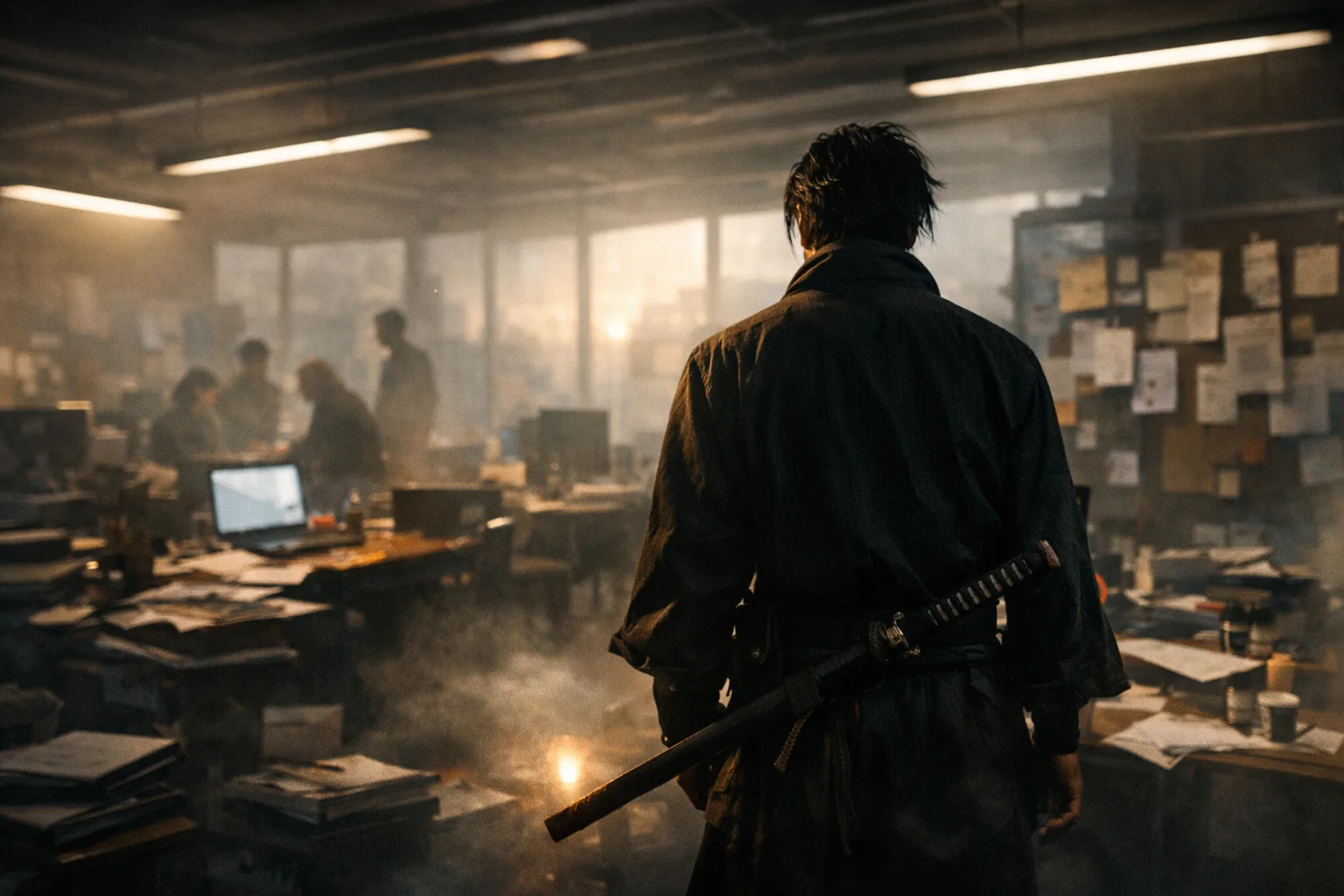
Every organisation needs a ronin.
Not in the cinematic sense, though the image is useful. I mean the organisational ronin: the masterless pattern-reader, the boundary walker, the trusted dissenter, the translator of weak signals, the person whose usefulness comes not from owning one square of the map, but from noticing what the map misses when everyone else is busy defending their own territory.
And if the title sounds a little unruly, good. It should.
The Trouble With Ownership
Traditional organisations are built around ownership. Who owns the customer. Who owns the process. Who owns the metric the technology, the incident, the decision. The language of modern work is thick with territorial logic, and for good reason. Ownership creates accountability. It gives things a home. It reduces drift. It offers a clean answer when something must be assigned, governed, explained, or escalated.
But ownership also has a shadow.
The more tightly work is divided into owned territories, the easier it becomes for the spaces between them to become strategically under-seen. A signal belongs nowhere until it becomes a problem for someone important. A handoff is treated as movement rather than vulnerability. An edge case remains “not mine” just long enough to become everyone’s. The customer experiences one journey. The system defends twelve different pieces of it.
This is where teams begin to need a different kind of person. Not merely someone who can execute inside a function, but someone who can see across them. Someone not fully captured by a single internal story. Who is not required to prove loyalty by staying inside the fence line of one department’s logic.
The more interesting question is whether we even know what to do with the people who are useful precisely because they do not fit so easily.
The Person the Structure Cannot Quite Place
Every organisation has them, whether it has language for them or not. The person who keeps noticing where the handoff fails, where the narrative changes between departments, where the official explanation sounds technically coherent but lived reality tells a messier story. The one who can move between frontline and strategy without needing a costume change. The person who understands enough of operations to smell fragility, enough of people to hear the tension in the room, and enough of systems to know when the process is solving for the wrong thing.
They are often hard to place in the old architecture because their usefulness is not narrow enough to fit a classic specialist box, yet too rooted in real conditions to be mistaken for a purely abstract strategist. They are not merely “cross-functional.” That phrase is far too clean. Cross-functional still sounds like a meeting. I mean the people whose minds naturally travel. Who connect what other people were trained to separate. The ones who are always slightly inconvenient to tidy hierarchies because they keep returning with truths that do not belong to a single owner.
In older organisations, these people can look unruly, politically awkward, over-curious, or structurally homeless. They do not always climb clean ladders. They may not present as the most polished inheritors of institutional legitimacy. They often gather influence sideways before the title catches up. They can seem untethered to managers who like a crisp chain of command. But in changing systems, they are often the ones keeping the organisation in contact with reality.
Why the Old World Distrusts Them
The ronin figure is not naturally comfortable to traditional systems because the old world is organised around legitimacy through placement. You are credible because you belong somewhere recognisable. You have a department, a span, a title, a reporting line, a bounded domain of authority. The structure can point to your box and explain why you are allowed to speak.
The ronin unsettles this. Their value often comes from precisely the thing the old structure distrusts most: permeability. They cross. They interpret. They reframe. They question. They connect one team’s blind spot to another team’s consequence. They are difficult to reduce to a single owned output because much of what they create is coherence, challenge, warning, synthesis, and design intelligence.
In other words, they create strategic value in forms that are often more alive than the structure’s language for recognising them.
This is why old systems tend to do one of three things with these people. They either under-use them, romanticise them without empowering them, or force them into conventional management tracks where their range gets dulled into administration. Sometimes they become the unofficial glue of the place, relied upon by everyone and properly recognised by almost no one. Sometimes they leave and are described, too late, as “unique” or “hard to replace,” which is usually organisational shorthand for we benefited from a capability we never properly learned how to name.
The New World Is Asking for Them Anyway
The irony is that the conditions now emerging across industries are increasing the value of exactly this kind of person.
The work is becoming more fluid, not less. AI is absorbing some of the repeatable surface layers while leaving behind more relational, interpretive, ethical, and context-heavy work for humans. Customer journeys cut across more systems. Decisions travel faster. Consequences show up in more places at once. Functions that once looked stable are now being asked to collaborate in real time with technologies, agents, workflows, and expectations that were not designed together. The neatness of the old map is collapsing under the lived mess of the terrain.
And that means the ability to hold context across boundaries is becoming a serious capability.
Not a decorative one. Not a “nice bridge-builder” personality trait. A real strategic capability.
The system now needs people who can sense where signal is thinning in transit. Who can interpret what one team sees as a local issue and recognise as a structural pattern. Who can stop the organisation from becoming too pleased with its own story. Who can bring contradiction into the room before failure does it more publicly. Who can work with AI without becoming hypnotised by AI. Who can translate between the machine’s answer, the human consequence, and the organisation’s stated values.
That person is not merely another job title bolted onto the old machine.
That person is evidence that the machine itself may need redesign.
This Is Not Just a Generalist
It is tempting to flatten the ronin into the familiar language of the generalist. There is overlap, certainly. The generalist has long been underestimated by systems obsessed with deep specialisation and tidy prestige hierarchies. And some of the capacities that matter here, range, curiosity, pattern fluency, contextual judgement, do live inside strong generalists.
But I think the ronin is doing something more specific. A generalist knows many things. The ronin moves between worlds. A generalist may have breadth. The ronin carries contradiction.
A generalist can contribute in many settings. The ronin often becomes valuable where ownership breaks down, where assumptions collide, where a consensus needs testing, where a handoff has quietly become a wound, where one department’s success has become another department’s burden, where the formal structure has ceased to reflect the live reality of the work.
The ronin is structurally unsettling in useful ways. That is what makes them different. And that is why organisations that are serious about adaptation cannot afford to mistake them for a vague category of “versatile talent” and leave it there.
The 10th Man, the Dissenter, the Keeper of Friction
There is another form this figure takes, and it matters enough to name directly. Sometimes the ronin is the 10th man. The deliberate dissenter. The one in the room who is not there to be difficult for theatre’s sake, but to protect the organisation from its own appetite for coherence. The person who asks the unwelcome question, tests the too-neat consensus, presses on the unexamined assumption, refuses to let the room confuse alignment with truth.
Every organisation says it values challenge. Far fewer build conditions where challenge can survive without becoming career-limiting. But systems moving this quickly, especially those integrating AI, changing workflows, and compressing decision cycles, are far too vulnerable to groupthink to treat dissent as a personality quirk. The more convincing the tools become, the more necessary the dissenter becomes. The more polished the dashboard, the more urgent the person willing to say: I think this picture is too clean.
This is not negativity. It is maintenance of intellectual oxygen. And without it, organisations do something very dangerous. They become efficient at telling themselves a story they no longer deserve to believe.
Where Do You Put a Ronin?
This is where my previous thoughts about developmental ladders would have started asking the wrong question. Because the instinct of the old system is always to ask where to place a person. At what level? In which team? On what rung? Reporting to whom? With which title? What line on the chart explains them? These are not illegitimate questions. They just reveal how limited the structure still is.
A ronin placed only at the top becomes ornamental. Too far from the friction, too abstract to smell the real damage early enough. At the frontline a ronin becomes underpowered. Rich in signal, poor in leverage. A ronin trapped in one specialist lane loses the very range that makes them useful.
So perhaps the more disruptive answer is this: the ronin should not be treated as a single role to place neatly on the ladder at all. It should be treated as a protected organisational function that exists in multiple forms at multiple levels.
At the frontline, the ronin is the signal carrier, the one who sees the strange pattern before anyone else agrees it is a pattern. Somewhere in the middle, the ronin is the translator, the person who keeps meaning alive through handoffs and stops local fixes from becoming wider harm. Near major decisions, the ronin becomes the dissenter, the red teamer, the one tasked not with pleasing the room but with testing whether the room deserves its confidence. At the top, the ronin becomes the orchestrator of permeability, the leader responsible for ensuring the organisation does not harden into self-protective certainty.
This is not a ladder. It is more like a nervous system.
Should This Introduce Chaos?
Yes.
A bit.
Not stupid chaos. Not vandalism or joker vibes. Not endless internal theatre masquerading as disruption. I mean productive chaos. The choas of creation. The kind that interrupts false coherence. That allows the new world to emerge before the old one has finished writing compliance language for it. The kind that keeps creation possible by refusing to let every useful thought arrive only through an approved channel.
Old systems optimise toward order because order feels governable. But too much order produces sterility. It produces surfaces without surprise, consensus without testing, stability without renewal. It produces organisations that can explain themselves beautifully right up until the moment the world moves and they discover they have built a temple to legibility rather than a living system.
A little protected chaos is often the price of genuine adaptation. The ronin brings some of that. They create tension where the structure wants reassurance. They slow consensus just enough for intelligence to re-enter. They carry outside weather into indoor certainty. They disturb the internal social contract that says belonging depends on not making the wrong people uncomfortable.
That discomfort is not the failure of the role. It is often the evidence that the role is working.
The Risk of Not Building for This Person
If organisations fail to make space for ronin-like capability, several things happen.
They continue over-rewarding owned certainty while under-rewarding cross-boundary intelligence. They keep forcing range into boxes too small for it. They miss patterns that sit between functions because nobody is responsible for carrying the whole. They produce strategies that sound aligned but arrive half-blind at execution. They let AI accelerate structures that were already too confident in the wrong places. They keep promoting the guardians of the current map while underusing the people who can tell when the map no longer matches the ground.
And, perhaps most costly of all, they keep teaching talented people that to be taken seriously they must become easier to place rather than more useful to the future. That is how systems train the next world out of the very people who could have helped build it.
A Better Question for the Fire
So this is the thought I want to leave by the fire tonight.
Every organisation needs a ronin.
Not because hierarchy is useless. Not because specialists no longer matter. And certainly not because ownership should dissolve into a romantic fog of borderless collaboration. But because the world now demands a kind of intelligence that old structures still struggle to house properly. Intelligence that moves. Intelligence that questions. Intelligence that connects what the map has separated. Intelligence that carries context across lines of ownership. Intelligence that stops the organisation from mistaking its own internal order for external truth.
The people the old system cannot quite place may not be the problem.
They may be the early architecture of the new one.
So, who are the ronin in your organisation already, and is the system learning from them, using them, or quietly training them to become less dangerous?