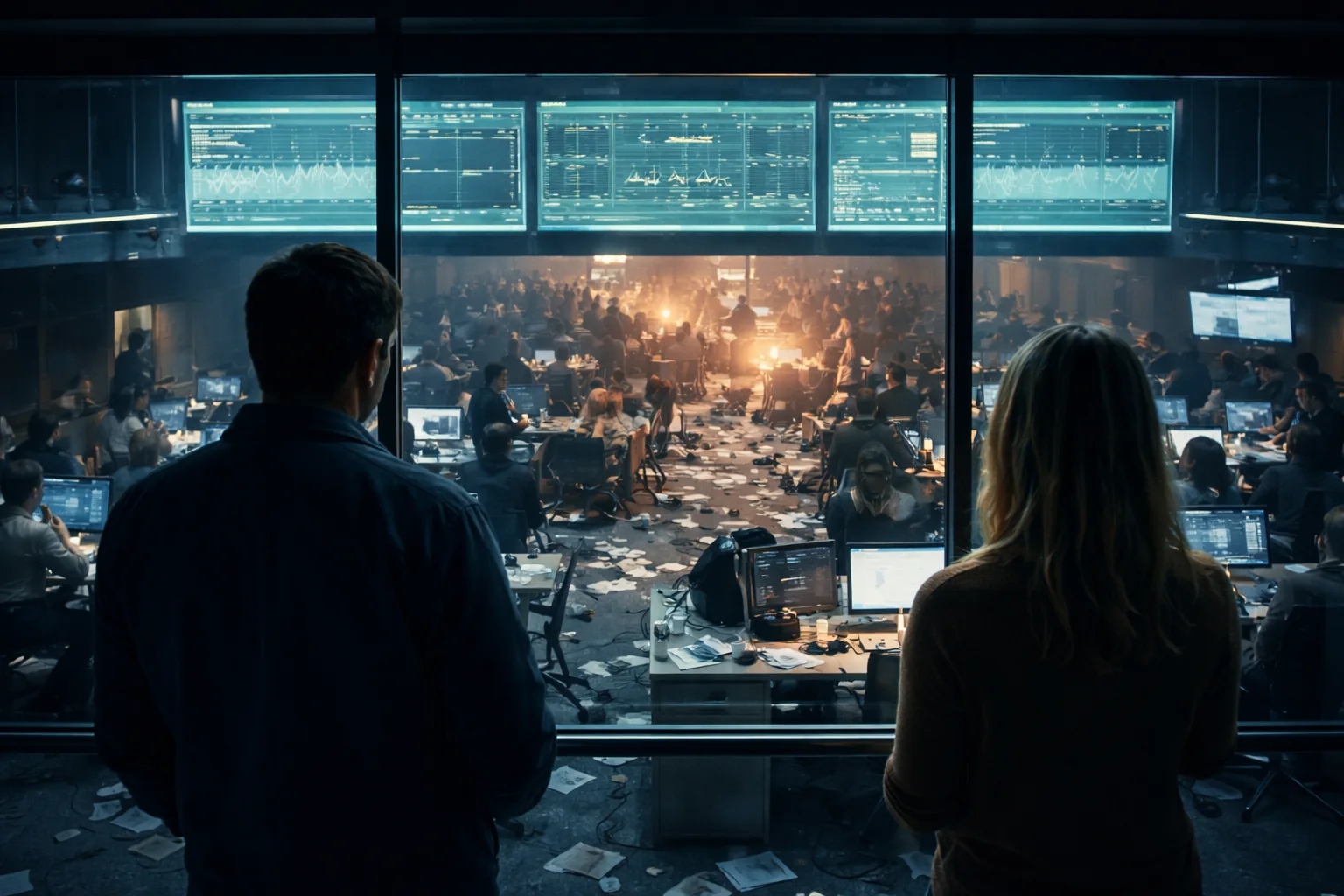
A Note Before We Begin
I wanted a new container for these conversations.
Less case file. Less verdict. Less standing in the fluorescent light trying to pin one culprit to the board. More working salon. More firelight. More room to place one theme on the table, turn it in the hand, and ask what the wider world of work may already be trying to tell us.
So consider this the opening of a digital fireside of sorts. A place for field notes, tensions, weak signals, awkward observations, inconvenient truths, and patterns that do not quite fit the official story. Not finished doctrine. Not performance. A working conversation.
And the first theme I want to place on the table is this: Some organisations are still designing for reassurance. Others are learning to design for reality. They are not the same thing.
The Difference Between Looking Calm and Being Alive
There is a difference between an organisation that wants to understand reality and one that wants to feel reassured about it.
One builds feedback loops, opens up signal, and adjusts in motion. The other builds dashboards, scripts, reporting layers, and tidy language designed to make uncertainty look manageable. Both may talk about excellence. Both may use the language of agility, innovation, transformation, or customer obsession. Only one is actually learning.
If you have spent enough time close to the work, you can feel the difference almost immediately.
In some organisations, the energy goes into understanding what is truly happening. The work is allowed to arrive as it is: messy, emotional, contradictory, occasionally impolite, rarely neat. The frontline says, this is what customers are struggling with. The system says, let us look more closely. A pattern emerges. Something is tested. Something is changed. Learning moves.
In others, the energy goes somewhere else entirely. The problem is translated upward until it becomes softer, tidier, and more acceptable for the next audience. What began as friction becomes a category. What began as a warning becomes a metric. What began as a live issue becomes an “insight” scheduled for later review. The customer still feels it. The frontline still absorbs it. The work is still straining under it. But on paper, the picture looks calmer than the truth.
That is not adaptation. That is aesthetic management.
Many organisations have become very sophisticated at producing the appearance of control. They know how to calm a dashboard. They know how to refine the language in a deck. They know how to turn a difficult pattern into a manageable narrative. They know how to reward the smooth relay of acceptable information upward through the hierarchy. But reality is not fooled by presentation. Reality waits in the queues, in the escalations, in the repeated contacts, in the workarounds, in the customer’s third attempt to explain the same thing, in the exhausted competence of people keeping the machine from embarrassing itself.
The question is not whether a system looks calm. The question is whether it is still alive enough to notice, interpret, and respond while the world around it is moving.
Why This Matters More Now
For a long time, reassurance was cheap enough to be mistaken for stability.
The process was mostly known. The customer journey was relatively legible. Change arrived in chunks. Exceptions could be shoved to the margins and labelled “edge cases.” The reporting cycle could afford to lag behind the truth because the truth itself was not moving quite so quickly.
That world is gone.
Customers move faster now. Expectations shift faster. Friction multiplies faster. The distance between design and lived experience collapses more quickly than many organisations can process. Technology is not simply adding efficiency. It is changing the shape of roles, the pace of judgement, the nature of escalation, and the threshold at which a human being is still needed. Work that once sat comfortably inside a script now spills over it. What used to be rare is becoming common. What used to be simple is becoming charged with emotion, context, and consequence.
And this is where the divide starts to matter. Because the organisations pulling ahead do not seem to be the ones speaking most beautifully about transformation. They are not always the noisiest. They are not necessarily the ones with the glossiest language, the most dramatic declarations, or the slickest theatre of reinvention. Often, they are the ones doing something much less glamorous and much more consequential.
They are opening frontline data up for real-time adjustment instead of treating it as a monthly artefact. They are building test-and-learn capability into the work itself rather than treating experimentation as a special event. They are using AI where speed, triage, and pattern recognition genuinely help, while preserving human judgement where ambiguity, trust, and care still matter most. They are beginning to value curiosity, adaptability, systems thinking, and interpretive skill because the old script no longer covers the work. They are redesigning end-to-end rather than adding another polished layer on top of a brittle foundation. These patterns emerged strongly in the earlier research that seeded this series, especially around frontline signal access, hybrid human-plus-AI models, and operating structures that adapt rather than simply contain .
Different industries are expressing this in different ways. Healthcare is being pushed toward more proactive, connected models of care. Operational environments are being forced to shorten the distance between signal and response. Customer-facing functions are being redrawn around the fact that speed without judgement is not service, only throughput. The most interesting point is not that every sector looks the same. It is that the deeper design principle seems remarkably consistent.
The strongest systems are becoming more reality-responsive.
The Corporate Addiction to Reassurance
Reassurance has its own internal logic, and it is not difficult to understand why organisations get attached to it.
Reassurance is comforting. It makes leadership feel informed. It helps reduce noise. It protects confidence. It allows order to survive long enough for the next meeting, the next quarter, the next board update, the next approval cycle. It gives people language to hold on to when the truth is still untidy.
It also flatters hierarchy. After all, if you build a system designed to refine reality into something more orderly before it reaches the top, then leadership gets to engage with the work in a form that is cleaner, calmer, and less emotionally costly than the version lived by everyone below. The friction has already been edited. The contradiction has already been translated. The pattern has already been reduced to what can be accommodated.
But this is where reassurance begins to distort. Because once a system becomes too committed to producing confidence, it starts to treat inconvenient truth as a threat to be managed rather than a signal to be welcomed. The frontline learns what kind of information travels well and what kind does not. The middle learns how to package ambiguity into something acceptable. The system slowly develops an immune response to reality.
It is a strange thing to watch. Many organisations do not fail because they lack data. They fail because they are structurally incapable of allowing the right truth to matter early enough.
The signal exists. The friction is already visible. The exceptions are already speaking. The workaround has already become normalised. The repeated contact is already pointing at a design flaw. The skilled person closest to the work already knows that the official story and the lived one have parted company.
What is missing is not information. What is missing is structural honesty.
Where the More Interesting Organisations Are Heading
What I find most compelling right now is not the language of disruption, but the quieter evidence that some organisations are learning how to stay in contact with reality while they operate. That sounds simple. It is not.
It means building systems that can notice sooner. It means shortening the journey between what is experienced and what is acted on. It means treating frontline teams not as a pain-absorption layer, but as an intelligence layer. It means designing escalation not merely as a relief valve, but as a learning pathway. It means admitting that the old distinction between strategy and operations was always a little too tidy. It means allowing more truth into the room before it has been deodorised. It also means being more honest about the role of technology.
There is a great deal of noise at the moment around AI as if the real question is whether it will replace people. That is not the most interesting question. The more useful question is this: where does automation make responsiveness easier, and where does it expose how much human judgement was doing all the real work in the first place?
AI can compress time. It can triage. It can summarise. It can surface patterns. It can support faster adjustment. But it also reveals something deeply inconvenient. Once machines take over the more repeatable work, what remains is often the work that demands context, ethics, emotional intelligence, discernment, timing, translation, and trust. In other words, it leaves behind precisely the work many organisations have under-valued for years.
This is why the better organisations are not only asking how to automate. They are also asking how to redesign around judgement. They are beginning to understand that human beings become more strategically important, not less, when the surrounding system grows more complex and more alive.
Reality-responsive design is not anti-technology. Quite the opposite. It is what stops technology from becoming another layer of reassurance theatre.
The Frontline Knows Before the Slide Deck Does
One of the great quiet absurdities of modern organisations is that the people closest to the work are often the last to be treated as serious interpreters of it.
They are expected to absorb the emotion, navigate the exceptions, notice the recurring pattern, hold the customer relationship together, and somehow continue to perform calm competence within a structure that does not always grant them the status of strategic thinkers. Then, weeks later, the pattern they were living inside arrives in a deck and is discovered afresh by people much farther from the smoke.
This is not simply inefficient. It is intellectually wasteful.
If you want to know whether a system is designed for reassurance or reality, one of the quickest tests is this: what status does it give to those closest to friction?
Are they there to contain the consequences of design? Or are they part of the organisation’s interpretive capacity? Do they merely keep things moving, or do they shape what gets understood and changed? Are they asked to perform resilience, or trusted to contribute intelligence?
A system designing for reassurance will usually prize smoothness over signal. It will celebrate control. It will be suspicious of ambiguity. It will prefer the cleaner story over the truer one.
A system designing for reality behaves differently. It understands that friction is information. It treats repeated exceptions as design intelligence. It assumes that the work is trying to tell it something. It takes the people nearest to lived complexity more seriously, not less.
The difference is not cosmetic. It is civilisational.
What This Means for Leadership
Leadership in a reassurance-driven system often looks composed. Leadership in a reality-responsive system often looks more exposed. That is because the second requires a different kind of courage.
It requires the courage to let the picture become messier before it becomes more accurate. The courage to stop rewarding neatness when neatness is purchased at the cost of truth. The courage to notice where the hierarchy itself is slowing learning down. The courage to hear something inconvenient without demanding it be translated into something less disruptive. The courage to accept that a polished reporting culture can quietly become an anti-learning system.
Many organisations talk about adaptability as if it were a skill issue. I am no longer convinced that is the deepest problem. In many cases, the capability exists. The people can see. The signal is there. The friction is not subtle. What fails is the structure’s willingness to engage honestly enough with reality for adaptation to become possible.
Which means the challenge is not merely operational. It is moral. What kind of truth can your organisation bear to know while there is still time to do something with it?
A Better Question for the Fire
So this is the thought I want to place on the table for the first gathering of this digital salon.
The next divide may not be between digital and traditional, or between companies with AI and companies without it, or even between efficient and inefficient.
It may be between organisations still designing for reassurance and those beginning to design for reality.
One wants the picture to look calm.
The other wants the system to stay alive.
And those are not the same thing.
If your systems are still built to reassure leadership rather than reveal reality, how quickly can you really learn?
And from your corner of the work, what are you seeing that the official story is still translating into something tidier than it is?