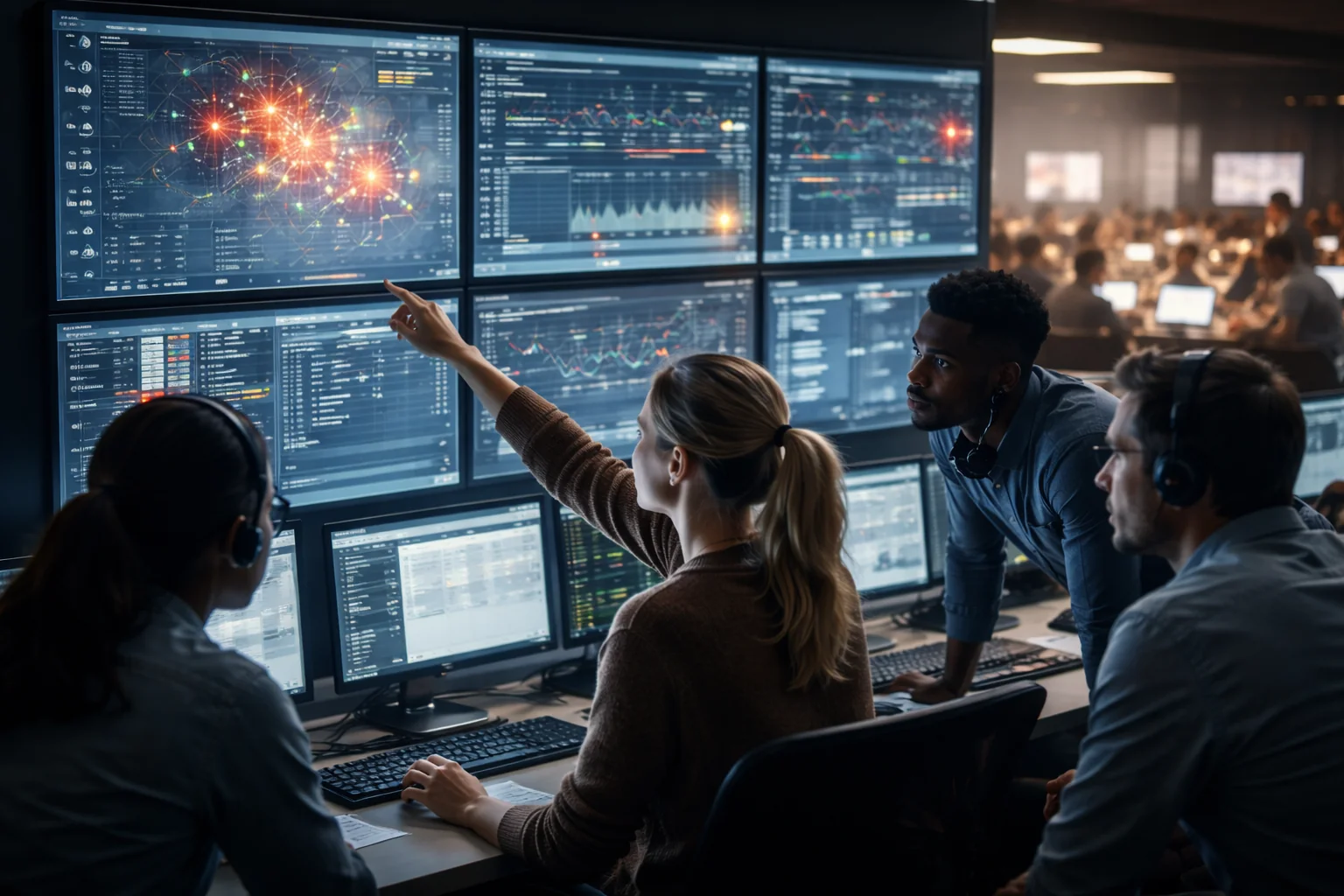
A Note for the Fire
If the first article in this series was about the difference between designing for reassurance and designing for reality, and the second explored why AI should handle speed while humans handle judgement, then this third conversation moves us to a place where those two questions meet the floor. Because there is a practical hinge hidden inside both of them.
A system cannot design for reality if the truth arrives too late. And human judgement cannot add much value if the people closest to the work are forced to operate half-blind.
So the theme I want to place on the table this time is this: What happens when the frontline can actually see the signal? Not just fragments. Not sanitised summaries. Not a monthly deck. Not a thin slice translated three levels up and back down again. The real signal. The patterns. The repeat contacts. The recurring exceptions. The emotional temperature. The weak tremors before something becomes a crisis. The context that makes the difference between “this looks fine” and “this is quietly going wrong”.
Because once the people nearest to the work can genuinely see what is happening, the organisation has a choice to make. It can become more alive. Or it can panic and tighten control.
Most Frontlines Are Asked to Carry More Than They Are Allowed to Know
There is something faintly absurd about the way many organisations still design frontline work.
The people closest to the customer, the queue, the friction, the repeated confusion, the escalation, the exception, the emotional fallout, and the workaround are often expected to absorb the consequences of system design without being granted the full visibility needed to interpret what they are seeing.
They are asked to fix without quite being allowed to diagnose. To soothe without being given the wider pattern. To respond without enough context to understand whether this is a one-off, a trend, a failure point, a risk, or an early warning.
So they stand in the weather while someone else studies the map. And then we call that efficiency. This is one of the strangest blind spots in modern organisations. The frontline is often treated as a resolution layer rather than an intelligence layer. A place where issues are contained, handled, and moved along. A human buffer between the customer and the machinery. Useful, necessary, emotionally demanding, but not always regarded as interpretive in its own right.
Yet anyone who has spent time close to the work knows that this is fiction. The frontline is not just where problems land. It is where patterns become visible first.
Signal Is Not the Same as Data
Part of the confusion here comes from the way organisations talk about information. We say “data” as though the mere existence of information means it is equally legible, equally meaningful, equally usable to everyone inside the system. It is not. Data is often abundant. Signal is rarer. And the ability to turn one into the other is not automatic.
A dashboard can tell you contact volumes are rising. It may not tell you that the tone of those contacts has changed from mild irritation to thinly veiled mistrust. A report may show repeat cases increasing in a category. It may not show that customers are all getting stuck at the same sentence, the same form field, the same contradictory policy explanation, the same emotional moment where reassurance should have arrived and did not. A routing system may classify issues correctly. It may not reveal that one issue, though technically “resolved,” is returning in altered form three days later because the original resolution dealt with the symptom but not the rupture.
That is where the frontline becomes so important. Because signal is not just what happened. It is the meaning carried in the recurrence, the friction, the hesitation, the language, the emotional residue, and the pattern beneath the pattern. And that kind of visibility is rarely produced by abstraction alone.
It is often produced where human beings remain close enough to the work to feel when something is off.
The Frontline Already Knows More Than Many Systems Admit
This is not a romantic argument. It is an operational one. In many teams, the frontline already has a form of knowledge that the wider system under-recognises. Not because they are magically wiser than everyone else. Not because proximity automatically equals insight. But because repeated contact with real conditions produces a kind of pattern fluency that is difficult to replace.
They know which “simple issue” reliably becomes a mess. They know which policy wording confuses people even when it is technically correct. They know which process sounds clean in documentation but consistently falls apart in live interaction. They know which escalation types are symptoms of larger design problems masquerading as customer error. They know when customers are angry at the thing in front of them and when they are angry because trust has been draining for weeks. They know when the queue feels normal and when it feels like a storm front. And yet, in too many settings, this knowledge remains trapped at the level of survival.
Handled. Logged. Endured. Repeated. Not elevated. Not synthesised. Not fed back in time. Not treated with the seriousness that a living system should give to the earliest point of truthful contact. This is where teams lose extraordinary value. Not because the signal does not exist, but because the structure does not know how to honour it while it is still warm.
Why Visibility Changes Behaviour
The moment the frontline can actually see signal, something important happens. Work changes shape. People stop being mere handlers of incoming pressure and start becoming interpreters of what the system is trying to say about itself.
That shift matters. Because when human beings are given richer visibility, they make different decisions. They spot recurrence faster. They escalate more intelligently. They recognise patterns earlier. They become less dependent on guesswork and more capable of judgement. They can distinguish noise from emergence. They become more proactive, not because a poster told them to “take ownership,” but because they can finally see enough of the terrain to act like owners of something real.
Visibility does not just improve execution. It changes identity. A person trusted with signal begins to experience their role differently. Less like a pain-absorption layer. More like part of the organisation’s sensing apparatus. Less like someone who simply takes the next thing in the queue. More like someone capable of helping the system notice itself.
This is one of the quietest and most important dignity shifts in work. To be trusted with signal is to be treated as a mind, not merely a pair of hands with a calming tone.
Control-Based Systems Often Fear This
Of course, not every organisation responds well to this possibility. Because signal can be unsettling.
Because once people at the edge of the work can genuinely see the pattern, certain comforts become harder to maintain. It becomes more difficult to ignore recurring defects that have already been absorbed into “normal.” The official story begins to look thinner where reality is thicker. Problems that once appeared isolated start to reveal themselves as connected, and the people closest to the work gain the evidence and pattern memory to say, with credibility, that something here is not behaving the way the dashboard suggests. For a control-based system, that can feel less like insight and more like disruption, because clearer visibility does not only reveal friction. It also shifts who gets to interpret what the organisation is really seeing.
So many organisations create a strange compromise. They want the frontline to be informed enough to perform, but not empowered enough to reinterpret the system. They want visibility without too much autonomy. Pattern recognition without too much challenge. Intelligence without too much redistribution of status.
This is where we get the familiar architecture of managed half-sight. Enough information to keep the machine moving. Not enough to meaningfully question why it moves this way at all.
But once the environment becomes faster, more volatile, more AI-shaped, and more dependent on human judgement at the edges, managed half-sight becomes a liability. Because people cannot adapt responsibly to conditions they are not allowed to understand.
AI Makes the Need for Frontline Signal More Important, Not Less
There is a very modern temptation to assume that as AI becomes better at pattern detection, the need for human signal interpretation will shrink.
I do not think that is right. In fact, I think the opposite may be true.
AI can absolutely help surface patterns, anomalies, emotional trends, repeat issues, and operational bottlenecks at a scale no human team could manually process. That is enormously valuable. It can bring buried patterns to light, compress time, and widen visibility across volumes that would otherwise remain opaque.
But this does not eliminate the need for human signal fluency. It intensifies it. Because once more information becomes visible, someone still has to decide what kind of pattern this is, what it means in context, whether it matters yet, what consequence it carries, whether it reflects a temporary fluctuation or a deeper structural issue, and what should be done before the system either overreacts or ignores something important.
AI can help surface signal. Humans still have to interpret significance. And the humans best placed to do that are often not the ones farthest from the work, but the ones closest to the friction, the queue, the recurrence, the emotional heat, and the design consequences of policy meeting reality.
The better the technology gets, the more foolish it becomes to under-value the human interpretive layer sitting nearest the live edge.
What Better Frontline Visibility Might Actually Look Like
This does not mean flooding teams with dashboards and congratulating ourselves for “democratising data.” Raw volume is not visibility. Interface is not understanding. Access is not design.
What matters is whether the signal becomes usable. Better frontline visibility might mean repeat-contact patterns surfaced in real time, not months later.
It might mean showing agents where certain issue types are spiking, where hand-offs are failing, where self-service is creating emotional escalation rather than relief, where policy confusion is clustering, where sentiment is shifting, where one supposedly resolved issue is quietly mutating into three more.
It might mean tools that let frontline teams annotate patterns, not just consume them. Systems where observation can travel upward with texture intact. Workflows where repeated friction becomes an improvement trigger rather than a private frustration. Structures where de-escalation, pattern noticing, and exception handling are treated as strategic input, not just good service hygiene.
It might also mean changing what we reward. Because if people are still measured mainly on speed, adherence, and queue throughput, then richer visibility will only produce a more sophisticated form of strain. They will see more, know more, feel more, and still be rewarded for acting as though none of it matters beyond the next contact.
That is not empowerment. That is informed helplessness. A reality-responsive system does something else. It pairs visibility with permission.
The Real Shift Is Not Information. It Is Trust
And perhaps that is the deepest layer of this whole question. Not whether the frontline can access more signal. But whether the organisation trusts them with what seeing it might change.
The minute people at the edge can genuinely see the pattern, the organisation is no longer dealing with a passive execution layer. It is dealing with thinking participants in the life of the system.
And that is why the deeper issue is not information alone, but trust. An organisation has to believe that the people closest to the work can make sense of what they are seeing, distinguish noise from significance, and escalate with judgement rather than panic. It has to believe they are capable of contributing more than surface-level resolution, and that a clearer view of reality will not make the system harder to manage, but more capable of learning. The real test is whether leadership is willing to let visibility change the role of the frontline from handler of consequences to interpreter of live conditions.
This is where many organisations reveal what they actually believe. Do they believe the frontline is there to perform competence? Or do they believe the frontline is capable of helping the organisation perceive itself more honestly?
Those are very different philosophies of work. And as environments become more fluid, more automated, and more dependent on judgement, I suspect the second philosophy will increasingly outperform the first.
Not because it is kinder, though it is. But because it is smarter.
A Better Question for the Fire
So here is the thought I want to leave on the table for this third gathering. What happens when the frontline can actually see the signal?
I think the answer is not just better performance. I think the answer is better sensing, better judgement, better escalation, better adaptation, and a more honest relationship between the system and its own reality.
The people closest to the friction stop being mere absorbers of consequence. They become interpreters of live conditions. And if that sounds destabilising to some organisations, it may be because too many systems still prefer a calm picture over a living one.
So from your side of the work, here is the question I want to leave by the fire:
Where in your world do the people closest to the truth still lack the visibility, permission, or status to help the system learn from what they can already see?