A Note for the Fire
If the first conversation in this series was about the difference between designing for reassurance and designing for reality, then this next one takes us straight into the machinery.
Because one of the most revealing questions in work right now is not whether AI is coming. That part is already settled. It is here, in the workflows, in the dashboards, in the summaries, in the routing, in the prompts, in the quiet redesign of what counts as effort and what now happens in seconds.
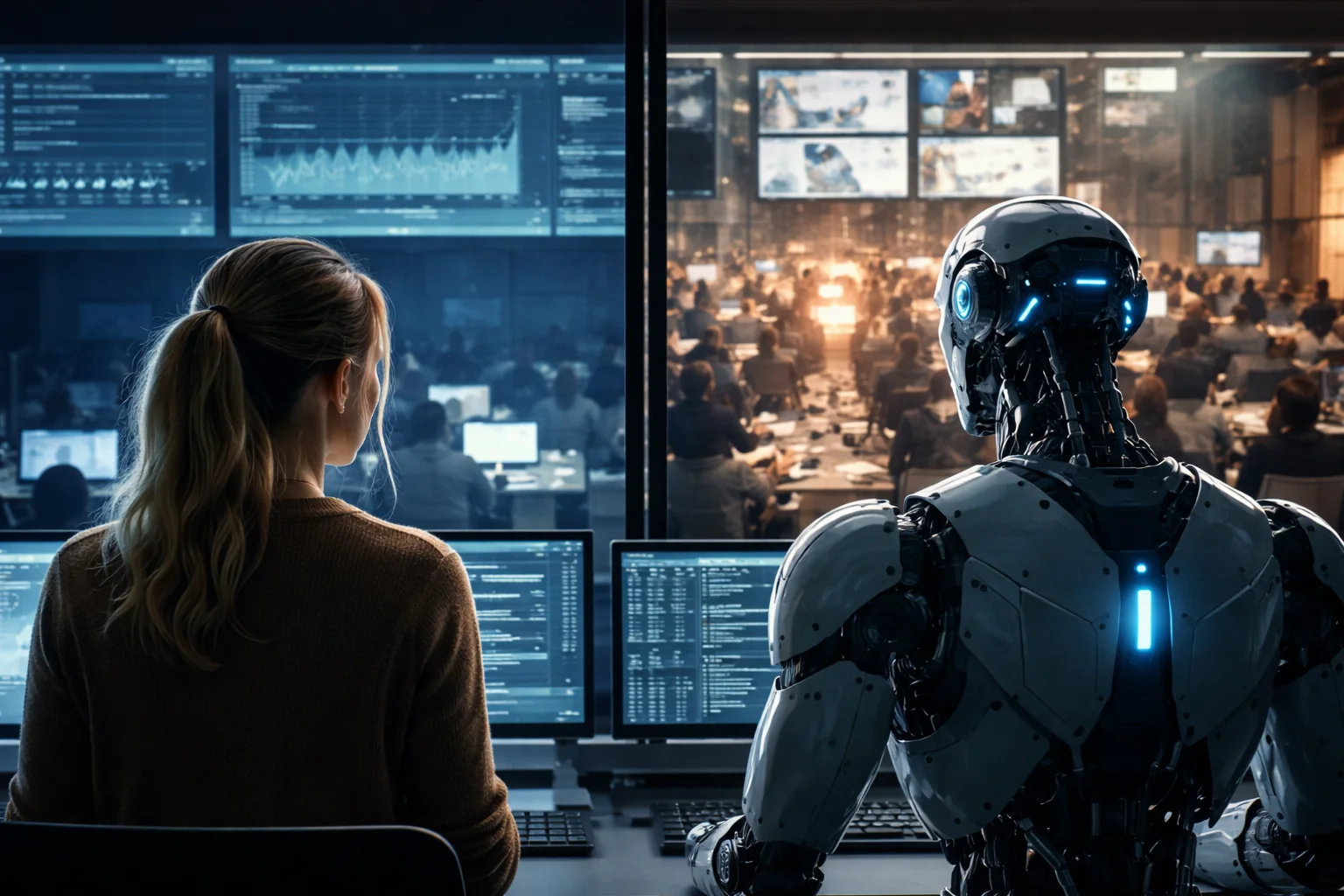
The more interesting question is this: What kind of human work becomes more valuable when speed is no longer the scarce thing? My answer, at least for now, is this: AI should handle speed. Humans should handle judgement.
Not because humans are slower. Not because machines are cold. But because judgement is what remains when the script runs out and the answer is no longer just informational. And increasingly, that is where the real work begins.
We Have Been Asking the Wrong Question
A great deal of public conversation around AI is still trapped inside an old drama. Will it replace people? Will it take jobs? Will it outperform us? Will it become more intelligent than the workers whose tasks it absorbs?
These questions are understandable, but they are also strangely blunt. They flatten everything into a contest between human and machine, as if the work itself were one undivided block waiting to be won by one side or the other. That is not how work feels when you are close to it.
When you stand near the actual point of friction, what becomes obvious very quickly is that most roles are not made of one thing. They are layered. Some parts are routine, repeatable, and highly compressible. Some parts are administrative drag disguised as responsibility. Some parts are pattern-matching. Some parts are coordination. Some parts are translation. Some parts are emotional containment. Some parts are discernment. Some parts are moral weight.
The problem with much of the current AI conversation is that it still speaks as though replacing the visible task means replacing the full human contribution. It does not. In many cases, it simply strips away the outer layer and exposes what the human was really doing all along. And often, what the human was really doing was judgement.
Speed Is Easy to Admire
Speed has always been seductive. It looks like competence. It photographs well in dashboards. It gives the satisfying illusion of progress. The queue is shorter. The answer arrived faster. The turnaround time improved. The handle time dropped. The system processed more in less.
None of that is meaningless. Speed matters. Delay creates friction. Uncertainty breeds anxiety. A customer waiting three days for a basic update is not experiencing sophistication. They are experiencing drag.
So yes, there is real value in allowing machines to handle the fast, the simple, the predictable, the repetitive, the easily classifiable. There is genuine relief in not asking human beings to spend their day doing work a good system can do faster, more consistently, and without fatigue.
But speed becomes dangerous the moment we confuse it with sufficiency. A fast answer is not always a good answer. A quick resolution is not always a real resolution. A compressed interaction is not always a trusted one. And in some organisations, speed has been over-rewarded for so long that it has quietly displaced a more important capability altogether: the ability to interpret what kind of moment this actually is.
That is judgement.
Judgement Is What Starts When the Script Ends
Judgement is not the same as expertise, although expertise can deepen it. Judgement is not merely knowledge, or logic, or experience, though all may feed it. Judgement is the ability to sense what this situation requires when the answer is not fully contained in the process.
It is what helps a person decide whether a policy should be applied plainly or explained carefully. It is what helps someone hear the tremor in a customer’s voice and understand that the issue is no longer only transactional. It is what tells a skilled worker that this case looks routine on paper but is actually heading toward reputational damage, ethical complexity, or human harm if handled mechanically.
Judgement is what allows one person to see a repeated exception not as an annoying outlier but as early design intelligence. It is what allows another to distinguish between urgency and noise, between emotion that needs containment and emotion that carries important signal, between compliance and care, between what can be automated safely and what should still pass through human hands because something more than efficiency is at stake.
Machines are getting very good at generating answers. That only makes judgement more valuable. Because once information becomes abundant, the scarce thing is not response. It is interpretation.
What AI Is Actually Good At
It helps, I think, to be less mystical about this. AI is very good at certain kinds of work.
It is good at summarising large volumes of information. It is good at spotting patterns across scale. It is good at triage, categorisation, ranking, drafting, prediction, recommendation, translation, and acceleration. It is often brilliant at removing dead time from systems. It can surface possible next steps, likely answers, historical comparisons, and early anomalies far faster than a human scanning manually ever could.
That is not small. In environments drowning in repeatable work, this is a genuine operational gift.
Good systems should absolutely use AI to reduce avoidable friction. Let the machine find the history. Let it summarise the thread. Let it pull the likely causes. Let it flag the duplicate. Let it suggest the next best action. Let it handle the status update, the reset request, the routing, the repetitive explanation, the routine reconciliation, the draft response, the first sweep of noise.
But let us also say the next part clearly. AI is good at acceleration. That does not mean it is good at consequence. It can suggest a response without fully grasping the relational cost of sending it that way, at that moment, to that person, under those conditions. It can make an interaction faster while making the overall experience thinner. It can reduce effort while also reducing felt care. It can clear the surface while missing the underlying fracture.
This is why the idea that “AI handles the routine, humans handle the complex” is helpful but still incomplete. Complexity is not always visible in advance. Some interactions become complex because judgement was missing at the very moment simplicity was assumed.
What matters is not complexity alone. What matters is whether the moment requires discernment.
The Most Human Work Was Often Hidden in Plain Sight
One of the strange ironies of this moment is that AI is making visible how much invisible human work organisations were under-valuing.
For years, many roles were described as though the work consisted mainly of output. Answering queries. Following steps. Processing cases. Applying policy. Resolving tickets. Closing loops. Moving things along.
But anyone who has actually done those jobs knows that this description was never the whole truth. The real work often sat underneath the task.
It sat in knowing when a person needed a different tone, not just a correct answer. It sat in reading what was not being said outright. It sat in deciding when to bend the sequence slightly to protect trust. It sat in calming without patronising. It sat in surfacing a risk before it escalated. It sat in knowing which exception mattered. It sat in protecting dignity while still protecting standards. It sat in translating between system logic and human consequence.
That work was often treated as soft, instinctive, secondary, or simply “good people skills.”
Now that the more repeatable surface layer is being automated, the underlying human layer stands in much sharper relief. Which means many organisations are discovering, perhaps to their surprise, that what remains is not lesser work. It is higher-order work. And if they continue to measure it with the old logic, they will miss the point entirely.
The Danger of Giving Machines the Whole Stage
There is another risk here, and it is not just about job design. It is about organisational temptation. Once a system becomes very good at generating speed, there is enormous pressure to keep handing it more of the stage. Faster is cheaper. Faster is scalable. Faster is measurable. Faster makes the chart behave. So the temptation is to let the machine move beyond acceleration and into areas where the real issue is no longer volume, but judgement.
This is where systems start to feel uncanny. Not because they are intelligent, but because they are misapplied. A machine can handle the mechanics of an insurance claim. It cannot carry the moral atmosphere of a bereavement. A system can recommend the next support step. It cannot fully hold the emotional shape of fear, humiliation, confusion, or rising distrust.
An algorithm can decide which case looks urgent. It cannot always understand what kind of reassurance, restraint, sensitivity, or courage the moment requires.
This matters even more in emotionally charged, ethically loaded, or trust-dependent environments. Finance. Health. Education. Escalations. Safety. Loss. Identity. Vulnerability. Ambiguity. Human error. Reputational risk. Situations where being technically correct is not yet the same as being wisely responsive.
The danger is not that AI becomes more capable. The danger is that organisations become lazy about where capability ends and judgement must begin.
Judgement Needs Better Status
If judgement is becoming more valuable, then it needs better status than most organisations currently give it. It cannot remain something we quietly hope for while structurally rewarding speed, compliance, and neat throughput above all else.
Judgement must be designed for.
That means hiring for it, training for it, recognising it, and protecting the conditions in which it can actually operate. It means moving beyond the fantasy that everything meaningful can be reduced to a standard flow without loss. It means acknowledging that some of the most important work cannot be fully scripted in advance because the point is not only to deliver an answer, but to interpret what kind of answer, explanation, escalation, or silence the moment requires.
It also means elevating the people who are good at this. Not only the polished strategists far from the work, but the frontline interpreters, the pattern readers, the de-escalators, the careful explainers, the ones who can feel when a situation is drifting and know how to intervene before it hardens into damage. Too many organisations still treat these abilities as personality traits rather than strategic capabilities.
That is an expensive misunderstanding. Because in the age of AI, judgement is no longer the nice extra that follows efficiency. It is increasingly the value layer sitting on top of it.
What Better Design Might Look Like
A better design logic begins with a simple question: Where does speed genuinely help, and where does judgement genuinely protect value? That question should shape far more than tool selection. It should shape operating models, role design, metrics, escalation logic, training, and leadership behaviour.
In a better system, AI handles the high-volume, repeatable, friction-heavy layers that drain human energy without adding much relational or strategic value. It clears the path. It gives context. It reduces dead work. It compresses lag.
The human role then becomes more intentional, not less. More about interpretation than retrieval. More about consequence than completion. More about trust than throughput. More about discernment than mere correctness.
In such a system, judgement is not left to chance. It is cultivated. Teams are trained not just on what the policy says, but on how to understand the situation in which it is being applied. Success is measured not only by speed, but by whether the outcome held. Whether the customer felt steadied. Whether the issue resurfaced. Whether trust was protected. Whether the exception taught the system something.
This is a very different philosophy of work. And I suspect it is where the more interesting organisations are heading, whether or not they have language for it yet.
A Better Question for the Fire
So perhaps the question is not whether AI will replace human work.
Perhaps the better question is this: What kind of human work becomes more visible once speed is no longer the scarce thing? My own answer is judgement.
The ability to read the moment. To interpret consequence. To balance care, standards, and context. To know when the machine is enough and when the human must step forward. To sense when the issue is no longer informational, but relational. To recognise what kind of response the moment can bear.
AI should handle speed.
Humans should handle judgement.
And if your organisation is still rewarding the first while under-valuing the second, then perhaps the system is accelerating faster than it is learning.
So from your side of the work, here is the question I want to leave by the fire:
Where in your world is speed improving, but judgement becoming more critical rather than less?