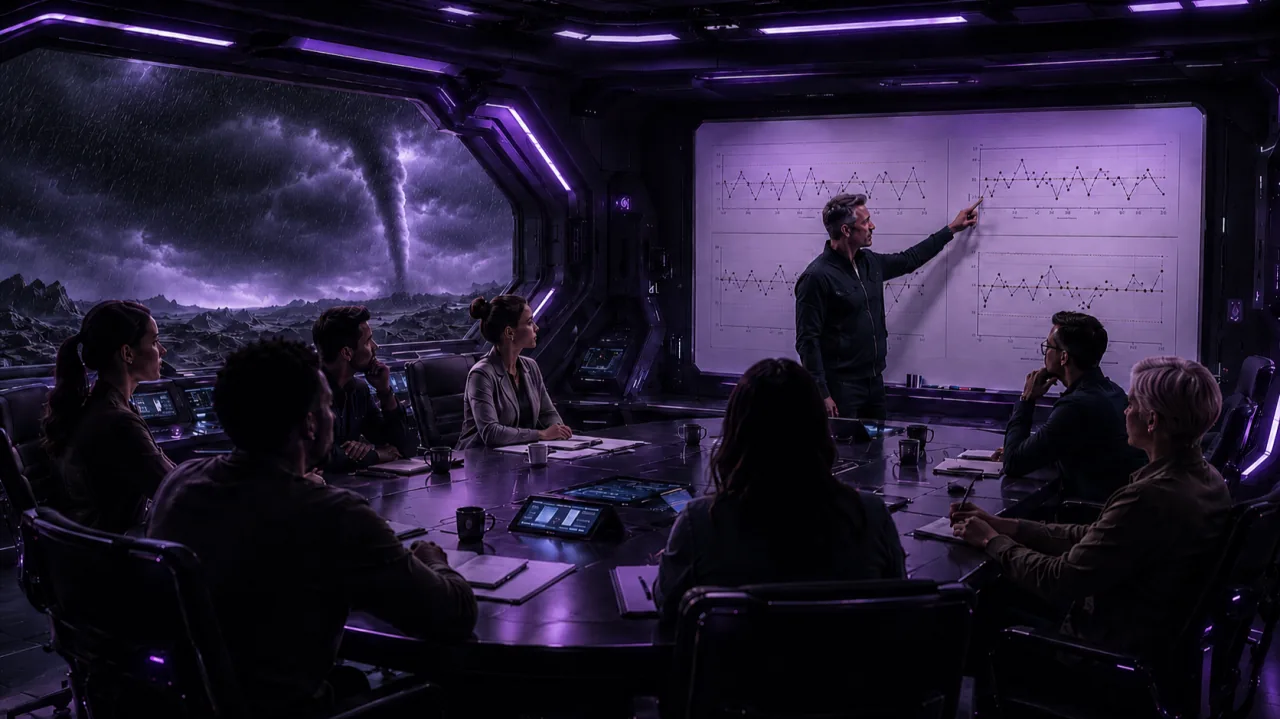
Have you ever watched a disaster movie and wondered how you would fare if you were the one standing in the middle of it?
Would you be calm in the cockpit while the storm builds? Would you read the radar properly, or would you immediately shout, “We are all going to die,” because one light started blinking? Would you be the storm chaser who understands pressure systems, or the person running dramatically through a field holding a clipboard and making poor choices?
Workplaces have their own weather patterns too.
Not the cinematic kind with flying cows, collapsing bridges, and someone yelling over a radio while the sky turns green. Usually it starts more quietly. One red metric. One ugly dot on a chart. One queue spike. One dip in customer satisfaction. One week where average handling time rises and suddenly the dashboard is giving off disaster-movie energy.
Before anyone has checked whether the movement is unusual, meaningful, or simply the normal wobble of the system, the organisation is already in storm mode. Someone asks for a deep dive. Someone else wants a recovery plan. A manager starts refreshing the dashboard like it owes them money. A meeting appears on the calendar with the words “urgent review” in the title, which is always how you know the barometric pressure has dropped.
This is how many teams manage performance. A number moves, and everyone reacts. A queue spikes, and the sirens go off. Customer satisfaction dips for a day, and suddenly there is a coaching campaign. Average handling time rises for a week, and the productivity sermon is polished and ready. Escalations increase, and the room begins hunting for the person, process, policy, system, or suspicious-looking cloud to blame.
Control Charts exist for exactly this reason. They are not there to make the dashboard look clever. They are there to stop the room from mistaking every gust of wind for a tornado.
Welcome to the Weather Channel of Work
Every process has weather.
Queue volumes rise and fall. Customer sentiment shifts. Defects move. Contact reasons change. Quality scores wobble. People have good days, bad days, strange Mondays, end-of-month pressure, post-release gremlins, seasonal weirdness, and the occasional Friday afternoon where the whole operation seems to be held together with caffeine and a stapler.
That movement does not always mean something has changed.
This is the part we forget. We look at a chart and behave as if every movement is a message. But some movement is simply the system being itself. A single data point can be loud without being important. A spike can look dramatic without being meaningful. A dip can feel personal without being evidence of failure.
The weather station matters because humans are not naturally brilliant at reading variation. We are emotional pattern hunters. We see a cloud and predict doom. We see three sunny days and declare summer. We see one red metric and start designing a corrective action plan before the coffee has cooled.
A Control Chart gives us a calmer question. Is this normal variation, or has the system actually shifted? That question is more powerful than it looks. It changes the conversation from panic to interpretation. It asks us to stop managing by dashboard mood and start reading the weather properly.
One Bad Tuesday Is Not a Climate Pattern
A Control Chart plots performance over time. It usually includes a centre line, often the average, and upper and lower control limits that help show the expected range of variation for that process. Those limits are the important part. They help us see whether the process is behaving within its usual pattern or whether something unusual may be happening.
In plain language, a Control Chart helps us separate noise from signal.
Noise is the normal wobble. Signal is the strange movement that deserves attention.
Organisations have a reaction problem. They overreact to single data points, underreact to slow patterns, and confuse ordinary system behaviour with individual failure. Then they wonder why teams feel exhausted, defensive, and suspicious of every dashboard.
A cloudy afternoon is not proof that the season has changed. One bad Tuesday is not a strategy. One red dot is not automatically a crisis. It may be the first sign of a storm, yes, but it may also be Tuesday wearing a dramatic cape.
The job is not to ignore the dot. The job is to understand it before turning the building into a bunker.
Common Cause: The System Being Its Dramatic Little Self
Common cause variation is the normal fluctuation created by the system as it currently exists. It is the ordinary weather pattern of the process. Not perfect. Not necessarily desirable. Just stable.
If a metric moves within the expected limits, the process may simply be doing what it usually does. That does not mean the performance is good. It means the variation is normal for that system. A stable process can still be painfully underwhelming. It can be predictably slow, predictably clunky, predictably irritating, or predictably unfair. Stability is not excellence. It is just consistency with a pulse.
This is where leaders often get into trouble. They see a point inside the normal range and treat it as a special event. Someone gets coached. A team gets interrogated. A new control is added. A meeting is born. The process was not signalling a crisis, but the organisation responded as though a tornado had just removed the roof.
If the movement is common cause, the answer is usually not, “Who messed up?” It is, “What does this system normally produce, and is that good enough?”
That question moves us from blame to design. It stops us from shouting at the clouds and starts asking why we built the town where the wind always hits hardest.
Special Cause: The Cow Just Flew Past the Window
Special cause variation is different. It is the unusual movement. The strange spike. The unexpected dip. The run of points above or below the average. The pattern that does not look random. The cow in the sky, if we are keeping the storm-chaser imagery alive.
This is where investigation makes sense.
A sudden increase in escalations after a policy change may be a signal. A sustained drop in quality after a system release may be a signal. A queue that behaves normally for months and then suddenly doubles may be a signal. A repeated pattern every Friday afternoon may be telling you something about staffing, handoffs, batch processing, customer behaviour, or the mysterious workplace curse of “we will get to it before the weekend.”
Control Charts do not remove curiosity. They aim it better. Instead of reacting to every wobble, the team can ask whether the data shows something unusual. If yes, investigate. If no, resist the urge to invent drama just because the chart briefly made eye contact.
A good storm chaser does not drive into every breeze. They watch pressure, direction, history, formation, and movement. They know the difference between weather that passes and weather that changes the map.
Leadership by Weather App Is Exhausting
There are teams that live under permanent dashboard weather warnings.
Green means calm. Amber means suspicion. Red means everyone must explain themselves before tea. The colour changes, and the mood changes with it. One week is celebration. The next is concern. A third is “what happened here?” A fourth is a new initiative with a name nobody likes.
This creates whiplash.
People stop trusting the measurement system because every movement becomes a performance conversation. Managers spend time explaining normal variation instead of improving the system. Frontline teams learn to dread the dashboard, not because they dislike accountability, but because the response to the data feels unpredictable and emotionally expensive.
If every wobble becomes a crisis, the team stops trusting the weather report.
This is not a small problem. Measurement should create clarity, not nervous system damage. It should help teams understand reality, not force them into ritual explanations every time a chart sneezes. When leaders respond to noise as though it is signal, they teach people that the safest strategy is not honesty. It is weatherproofing themselves against management reaction.
That is storm fatigue.
The Dangerous Art of Fixing the Wrong Weather
There is a classic Control Chart lesson called tampering, and it deserves more attention than it gets.
Tampering happens when we interfere with a stable process because of normal variation. We tweak, coach, adjust, redesign, escalate, or correct something that was not actually signalling a special problem. The intention may be good, but the effect can be harmful. By reacting to noise, we can make the system worse.
This happens constantly. A leader changes a process because one week looked bad. A manager coaches an agent because one score dipped, even though the score sits within normal variation. A team adds another checklist after one incident, creating more friction without reducing risk. Targets get moved because the chart twitched. Controls get layered onto controls until the process resembles a disaster bunker built by anxious raccoons.
Sometimes the most dangerous fix is the one applied to noise. That sentence should be taped to several dashboards.
Not every disappointing result requires intervention. Sometimes it requires observation. Sometimes it requires more data. Sometimes it requires understanding the baseline. Sometimes the right leadership move is to resist the urge to do something performative just to prove one is paying attention.
Doing nothing is not always neglect. Sometimes it is discipline.
When the Storm Is Real, Stop Admiring the Radar
Of course, the opposite danger also exists.
Control Charts are not an excuse to become serene while the roof is leaving the building. If the pattern is real, act. If the data shows a genuine shift, a sustained run, or a point outside the expected limits, the team should not explain it away with “variation happens” while customers are being flung across the metaphorical Kansas landscape.
The purpose of understanding variation is not to become calmer for the sake of calm. It is to respond properly.
If the system is stable, improve the system. If there is special cause variation, investigate what changed. If the chart shows a sustained improvement, understand what created it before declaring victory. If it shows sustained deterioration, do not wait until the customer complaints arrive wearing helmets.
Control Charts should make us less dramatic about noise and more serious about signal.
That is the balance. Do not panic at clouds. Do not ignore the tornado.
The Frontline Smells the Rain First
The frontline often senses the shift before the chart confirms it.
They know when a queue feels different. They notice when a new policy has changed customer behaviour. They can hear when a system release has made customers more confused. They see when a contact reason that used to be simple has become sticky, emotional, or weirdly hard to resolve. They know when the “normal wobble” has a different smell.
A Control Chart should not be used to silence frontline experience. It should help test it, validate it, and translate it into evidence. The frontline may say, “Something has changed.” The chart helps ask, “Can we see the pressure changing too?”
That partnership is powerful. Human signal plus data signal. Lived experience plus statistical discipline. Weather instinct plus weather station.
The mistake is choosing one over the other. If we only trust the chart, we may miss early signs that have not yet become visible in the data. If we only trust instinct, we may overreact to what feels dramatic but is still within normal variation. Together, they create a better forecast.
The frontline is often the first barometer. The chart helps prove whether the pressure is really changing.
AI Should Be Weather Radar, Not a Louder Siren
AI has a useful role to play here, especially in complex service environments where variation appears across queues, channels, categories, sentiment, quality, defects, rework, repeat contacts, and escalations.
AI can help monitor patterns faster than humans can manually review them. It can flag unusual shifts, cluster anomalies, surface emerging contact reasons, compare current behaviour to historical baselines, and detect when small changes begin forming into something meaningful. It can act like weather radar, scanning the horizon while the humans are busy flying the aircraft, calming the passengers, and wondering why the left engine sounds emotionally unavailable.
But AI should not become another panic machine.
If AI simply creates more alerts, more dashboards, more noise, and more “urgent insights” without interpretation, then all we have done is automate anxiety. A louder siren is not better governance. A smarter system should help distinguish between expected movement and meaningful change. It should support judgement, not replace it with a confetti cannon of notifications.
AI should not make the dashboard louder. It should make the signal cleaner. That is the standard.
Stop Building Disaster Movies Around One Dot
The disaster movie version of leadership is very tempting.
A single data point appears. The music changes. Someone dramatically turns towards the screen. The room goes quiet. A leader says, “Enhance that chart,” as if the spreadsheet is hiding a villain in the pixels. Then the whole organisation runs towards action before anyone asks whether the data point belongs to normal variation.
It makes for excellent cinema and terrible management.
Control Charts ask us to grow up a little. They ask us to stop building disaster movies around one dot. They remind us that performance exists over time, not in isolated emotional moments. They give us a way to look at the system with more patience and less theatrical sweating.
This is especially important in customer service and operations because the work is naturally variable. Customer behaviour is not a conveyor belt. Demand shifts. Emotions fluctuate. Volume patterns change. External events interfere. A perfectly stable line may look comforting, but it is rarely the truth of living work.
The goal is not to eliminate all variation. The goal is to understand which variation belongs to the system and which variation is trying to tell us that something has changed.
That is a much more adult conversation than, “Why is this number red?”
How to Use Control Charts Without Becoming a Statistical Goblin
You do not need to become a statistical goblin living under a bridge of formulas to use Control Chart thinking well.
Start with a metric that matters and track it over time. Make sure the data is reasonably consistent and collected in the same way. Understand the context of the process before interpreting the chart. Look at patterns, not isolated drama. Ask whether the movement falls within expected limits or whether it suggests something unusual. Separate normal variation from special cause variation. Do not punish individuals for system behaviour. Do not redesign the process because of one ugly dot with a flair for theatre.
When the chart shows normal variation, ask whether the system itself needs improvement. When it shows something unusual, investigate what changed. When the chart shows improvement, confirm whether the improvement is real and stable before declaring victory. When it shows deterioration, act before the storm becomes a franchise.
Most importantly, use the chart as a conversation starter, not a courtroom exhibit.
A Control Chart should not be waved around like evidence of personal failure. It should help the room ask better questions. What is normal here? What changed? What does the process usually produce? What is outside expectation? Where should we investigate? What should we leave alone until we understand more?
That is the work. Less panic. More weather literacy.
Respect the Weather Before You Redesign the Planet
A healthy organisation does not panic at every gust of wind, and it does not ignore a storm front forming on the horizon. It learns to read the sky.
Control Charts matter because they teach us to respect variation. They remind us that not every wobble is a crisis, not every red dot is a scandal, and not every spike deserves an action plan wearing a hard hat. They also remind us that real signals deserve serious attention, especially when the pattern shows that the system has changed.
The goal is not calm for its own sake. The goal is better judgement.
When leaders understand variation, they stop managing through mood swings. Teams spend less time defending normal weather and more time improving the climate. Frontline insight gets paired with data instead of dismissed by it. AI becomes radar instead of noise. The dashboard becomes a tool for learning, not a little electric panic box glowing in the corner.
Not every wobble is a crisis. But when the pattern is real, the chart will show you where the storm is forming.