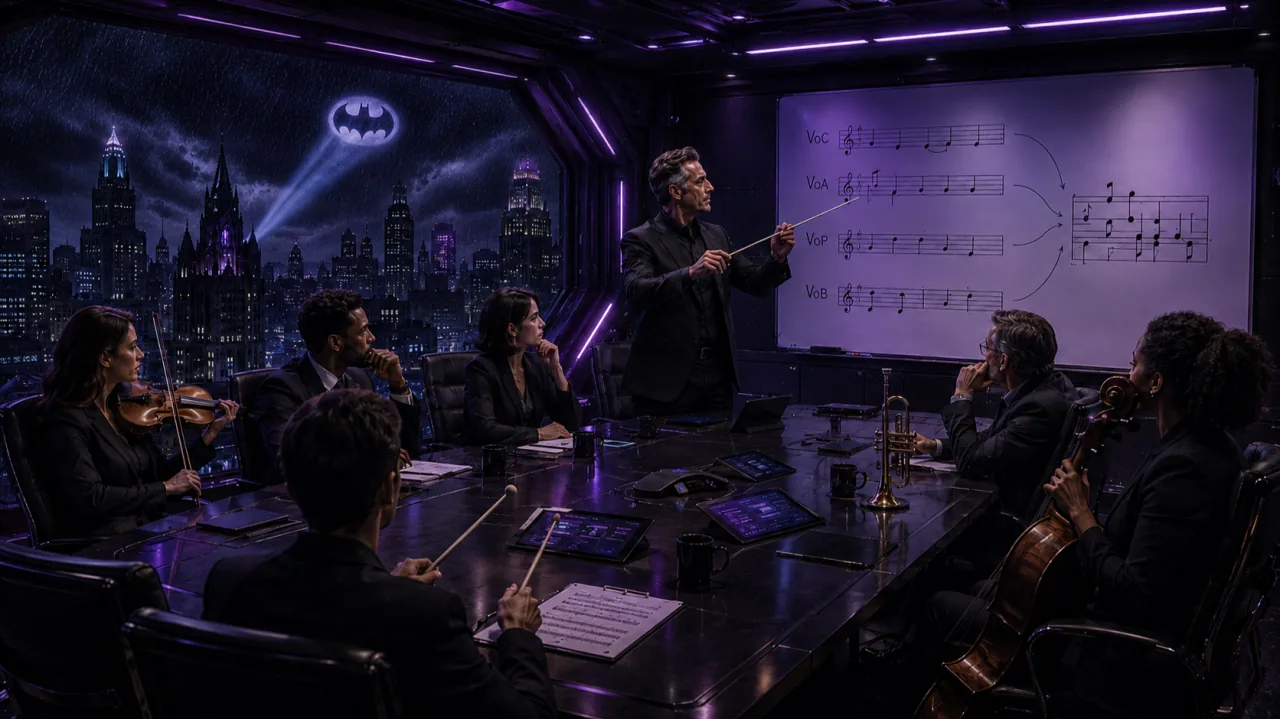
Who does not love a bit of Batman? I am a fan of the films, yes, but if I am honest, it is the soundtrack that gets me every time. I listen to those scores almost as often as I rewatch the trilogy, because the music does something the dialogue cannot always do. It tells you what is shifting beneath the scene. It lets you feel the city breathing before anyone says a word.
Long before the danger steps into the light, the score starts changing. A low note enters. The strings tighten. The percussion becomes almost too quiet. The city seems to hold its breath. Nobody has thrown a punch yet. Nobody has revealed the villain. Nobody has lit the Bat-Signal. Yet you already know something is wrong because the music has started telling the truth before the scene has caught up.
That is why, when I think about the different voices in a project or a problem, I do not picture a neat little feedback table. I picture the score. Organisations have that music too.
A customer complaint lands. An associate sighs in a team chat. A process metric starts drifting. A backlog grows quietly in the corner. Finance asks why the cost is climbing. Compliance raises a risk. A leader wants the issue fixed by Friday, preferably with no additional headcount, no uncomfortable trade-offs, and a slide that says “stabilised” in reassuring blue.
Everyone is hearing something, but not everyone is hearing the same thing. The customer is saying, “This is not working for me.” The associate is saying, “This is not workable from where I sit.” The process is saying, “This is what I actually produce.” The business is saying, “This is what we can afford, tolerate, risk, or prioritise.” And somewhere in the middle of all that, leadership asks, “Why does this sound so messy?”
Because it is messy. The problem is not that organisations lack voices. The problem is that they often listen to one section at a time, then call that partial hearing insight. The room has not heard the whole score yet. It has only heard the loudest instrument.
That is where improvement work begins: not by turning up the loudest section, but by asking what the full score is trying to tell us.
The Signal in the Sky
Voice of the Customer is often the first signal we take seriously because it arrives with visible urgency.
Complaints. Bad reviews. Escalations. Survey comments. Repeat contacts. Abandoned journeys. Refund requests. Social media posts. Silence after a bad experience. The customer voice is the Bat-Signal in the sky. It does not explain the whole case, but it tells us where the city is hurting.
Customers tell us where trust is breaking. They show us where expectations are not being met. They reveal where the experience feels confusing, unfair, slow, cold, or unnecessarily difficult. They may not use operational language, but they know when the experience has failed them. They may not say, “Your upstream handoff design has introduced hidden rework,” but they will absolutely say, “I have already explained this three times and nobody is helping me.”
That is signal. But the Bat-Signal does not solve the case. It tells Batman where to look.
This is where organisations sometimes lose the plot. They hear the customer complaint and immediately sprint towards the most obvious fix. Customers say agents are unhelpful, so the business adds coaching. Customers say the process is slow, so the business sets a speed target. Customers say communication is poor, so someone writes another template that smells faintly of policy and mild despair. Sometimes those actions are useful. Often, they only treat the symptom the customer can describe.
The customer can tell you where it hurts. They cannot always tell you what caused the pain. VOC is the melody. It carries the emotional theme. It tells us what the audience feels. But the melody is not the whole score.
The Alleyway Whispers
If VOC is the signal in the sky, Voice of the Associate* is the intelligence from the street.
This is the voice of the people close enough to the work to feel the friction before the dashboard admits anything is wrong. Frontline agents. Team leads. Quality reviewers. Escalation owners. Analysts. SMEs. Process operators. The people who know where the official process and the lived process quietly parted ways three system releases ago and nobody updated the map.
VOA often arrives in humble clothing. “This keeps happening.” “Customers always get stuck here.” “The policy sounds simple, but it is horrible to explain.” “The tool does not show us what we need.” “We have a workaround.” “The handoff is where it goes to die.” “We can close the ticket, but the customer is not really sorted.” That is not noise from the floor. That is the system speaking through the people carrying it.
The tragedy is that associate voice is often treated as informal, emotional, resistant, or anecdotal. Because it does not always arrive as a polished dashboard, it gets downgraded and diluted. It comes with frustration; it gets dismissed as change fatigue. Because it comes from people who are expected to execute, not design, it is sometimes heard as complaint rather than intelligence.
But the frontline hears the score differently. They hear when the customer melody starts turning sour. They notice when the process percussion falls off-beat. They feel when the business bassline becomes so heavy that nobody can breathe. And they can usually tell when “just follow the process” has become operational fiction.
Voice of the Associate does not replace data. Ignore it, and you may still have a beautiful reporting pack. But you might just have a reporting pack that missed the alleyway whispers before Gotham caught fire.
The Footsteps in the Dark
Voice of the Process is the rhythm underneath the scene. It is not what the SOP says should happen. It is not what leadership believes happens. It is not what the customer wishes happened. It is what the process actually does when the music starts.
Cycle time. Rework. Defects. Variation. Handoff delays. Repeat contacts. Backlog ageing. Error rates. First-time-right performance. Contact reasons. Queue health. Failure demand. Process drift. Escalation patterns. This is the beat with receipts.
VOP is powerful because it grounds the room. It protects us from vibes. It helps us see whether a problem is isolated, recurring, stable, worsening, improving, shifting, or simply doing what the current system was designed to produce. It shows us the tempo. It reveals whether the process is dragging, rushing, looping, missing beats, or quietly producing the same disappointing result with impressive consistency.
But process voice has its own danger. A process can be perfectly stable and still perfectly wrong.
A dashboard can show consistency while customers suffer. A workflow can meet internal service-level agreements while the customer gets transferred four times and slowly loses faith. The process may be efficient at producing the wrong outcome.
That is why VOP cannot be heard alone. If the process voice dominates, the organisation may become technically neat and emotionally tone-deaf. The chart says stable. The customer says painful. The associate says impossible. The business says expensive. All four can be true.
The process voice tells us what the system is doing. It does not automatically tell us whether the system is worth defending.
The Low Brass of Consequence
Voice of the Business is not the villain. This matters, because it is easy to frame business constraints as the cold, corporate monster stomping through the city. But VOB carries real weight. Cost exists. Risk exists. Compliance exists. Capacity exists. Revenue, regulation, brand promise, strategy, staffing, tooling, scalability, sustainability: none of these can be wished away by a passionate customer quote and a dramatic swivel chair moment.
The business voice is the low brass of consequence. You may not always notice it consciously, but you feel it in your chest. It gives the score gravity. It asks whether the solution can scale. Whether the fix creates risk somewhere else. And it asks whether the organisation can afford the intervention, sustain the staffing model, defend the policy, comply with regulation, and still keep the lights on.
VOB is essential. The danger begins when it becomes the only sound in the room. When VOB dominates, every conversation starts translating itself into cost, productivity, containment, contact avoidance, efficiency, risk reduction, and capacity management. Those things are not wrong. They are incomplete. The business may become very good at saving money while slowly spending trust. It may reduce contacts by making it harder for customers to reach anyone. It can improve handle time by discouraging proper investigation. It may also celebrate self-service while customers quietly experience it as abandonment with a search bar.
The business voice provides gravity. It should not become a black hole. A healthy organisation does not silence VOB. It also does not let VOB swallow every other voice and then call the silence alignment.
When the Hero Theme Gets Too Loud
Every organisation has a favourite instrument, usually for very human reasons. Leaders lean towards the voice that matches their pressure. Middle managers lean towards the voice they can influence. Teams lean towards the voice they can measure. And everyone, eventually, starts favouring the voice that feels safest to defend in a meeting.
Sometimes that favourite instrument is the customer voice. The complaint arrives, reputational risk appears, leadership feels the heat, and suddenly the whole system bends around the loudest customer pain. That can be necessary. It can also make the organisation reactive, over-accommodating, and permanently stuck in rescue mode.
In other rooms, the business voice takes over. Efficiency becomes the hero theme. Cost reduction swells. Productivity marches in with brass and drums. The music sounds powerful, but the customer melody has disappeared and the frontline strings are snapping in the corner.
Then there are places where the process voice dominates. The workflow is documented. The SLA is green. The control chart is stable. The process owner is calm. Meanwhile, customers are still confused, associates are still inventing workarounds, and the business is wondering why the numbers look fine but the experience feels haunted.
The work is not to decide which voice wins. The better move is to understand which voice needs to carry the theme in that moment, and how the others should support it. In a good score, one instrument can step forward without the rest of the orchestra disappearing. The strings may carry the emotion, but the percussion still holds the pace. The brass may bring the weight, but the quieter notes still shape the tension. The melody leads, but the arrangement gives it meaning. Improvement works the same way.
Batman Does Not Chase Every Noise in the City
A city in trouble is noisy. Sirens. Footsteps. Engines. Rain. News reports. Whispers. Alarms. A suspicious noise in an alley. A louder suspicious noise on a rooftop. A villain monologue, because apparently crime also needs theatre.
Batman does not chase every sound in Gotham. He listens for pattern, consequence, location, motive, and risk. He follows clues, not volume. Organisations need the same discipline.
Not every customer complaint requires a full project. Not every associate frustration is a root cause. Not every process variation is a crisis. Not every business concern should override the human experience. The skill is learning which signals deserve investigation, which deserve monitoring, which deserve validation, and which are simply noise produced by a complex system in motion.
That does not mean dismissing smaller signals. We have already made that mistake with Pareto. The long tail still matters. The point is not to chase everything with the same intensity. The point is to design attention properly.
Some signals need immediate action. Others need a trend view. A few require root cause investigation. Certain patterns need CTQs, a process map, a policy review, leadership courage, or an AI-assisted scan because the evidence is too faint, fragmented, or distributed for humans to catch manually.
The discipline is not in hearing everything equally. The discipline is in knowing how to respond differently without making the quiet signals disappear.
The Crime Scene Is in the Dissonance
The most useful moment in improvement work is often the most uncomfortable one.
VOC says customers want faster resolution. VOA says agents need more authority to resolve properly. VOP says the current handoff adds three days. VOB says giving more authority creates risk exposure. Now the room gets tense.
Good. That tension is not a distraction from improvement. That tension is the crime scene.
This is where many organisations rush too quickly towards agreement. They want harmony before they have understood the dissonance. They flatten the voices into a compromise nobody believes in. They create action plans that sound sensible and solve very little. They pick the least politically expensive interpretation and move on.
But friction between the voices is often where the real design challenge lives.
If the customer needs speed and the business needs control, the work is not to decide who wins. It is to design a process where speed and control can coexist without turning the customer journey into a hostage negotiation.
If associates need authority and compliance needs guardrails, the choice is not blind trust or total restriction. The better question is what decision rights, controls, training, thresholds, and escalation paths would allow judgement without chaos.
If the process data says stable but customers still complain, the issue is not whether customers are wrong or the data is wrong. The real question is whether the process is consistently producing an experience that fails to meet customer requirements.
Dissonance is not failure. It is the scene telling the truth.
A great film score knows how to use tension. It does not remove every uncomfortable note. The low strings make you uneasy. The percussion creates urgency. The silence makes you lean forward. The brass carries consequence. The composer does not ask every instrument to play the same note because that would not be harmony. It would be a very expensive hum.
Improvement works the same way. The friction is not the enemy to vanquish.
The Silence Before All Hell Breaks Lose
Sometimes the most important voice is the one that has gone quiet. In film, silence can be more dangerous than sound. It is the pause before the engine growls. The breath before the leap. The stillness before the city erupts.
A quiet Gotham street does not always mean the city is safe. Sometimes it means everyone has learned to stay indoors. A silent alley can mean the threat has already passed through. A calm skyline does not always mean the system is healthy. Sometimes the trouble is underground, moving through tunnels, sewers, basements, and all the places the camera has not shown us yet.
That is the danger with silence in organisations too. We mistake the absence of noise for the presence of health, when sometimes it is only the calm before the storm.
Organisations are often terrible at interpreting silence. Complaint volume drops, and customer happiness is quietly declared. Engagement comments become polite and thin, so associate alignment gets ticked off as healthy. The dashboard stays green, which makes the process look well behaved. The numbers still hold, so the business is treated as stable.
Silence can mean peace. It can also mean resignation, fear, fatigue, or the kind of stillness that arrives when people have stopped believing anyone is coming.
Customers may stop complaining because they have stopped believing anyone will listen. Associates may stop raising issues because nothing changes. Processes may look stable because the categories are too blunt to show the truth. Business results may look fine because the cost of poor experience has not yet arrived in a format finance recognises.
A mature listening system does not only ask what is loud. It asks what has disappeared. Where have complaints dropped but repeat behaviour increased? Where has frontline feedback gone quiet after months of escalation? Where does the process look clean because everything difficult is hidden in “Other”? Where has the business reduced cost but increased invisible effort somewhere else?
The silence before the crescendo matters, and let's not call it harmony just because nobody screamed.
Six Sigma Is the Detective Board, Not the Cape
Six Sigma is not the cape. It does not swoop through a skylight, glare at the room, and save the day through dramatic posture. It is less glamorous than that and far more useful.
Six Sigma helps us pin the clues where they belong. It gives structure to competing voices. It helps translate what customers need, what associates experience, what the process produces, and what the business requires into something the organisation can actually work with.
VOC becomes requirements. VOA becomes operational feasibility, friction points, usability risks, and lived system intelligence. VOP becomes baseline, variation, defect patterns, process behaviour, and evidence. VOB becomes constraints, strategic priorities, risk boundaries, cost realities, and sustainability requirements.
Only then does the work begin. What is Critical to Quality, meaning what must be true for the customer requirement to be met in a measurable way? What must be true for the associate to deliver the work? What must the process be capable of producing consistently? What must the business protect, fund, control, or prioritise?
This is where Six Sigma brings the wider lens. It does not simply ask, “What does the customer want?” It asks how that need travels through the system, where it becomes a requirement, where it breaks, who carries the pain, what the process actually does, and what the business must balance. That is not bureaucracy. That is disciplined listening.
A conductor does not make music by letting the loudest instrument win. A detective does not solve a case by interviewing one witness and ignoring the crime scene. Batman does not save Gotham by staring at the Bat-Signal and refusing to walk into the alley.
The method matters because the city is complicated.
AI Can Hear the City, But It Cannot Be Batman
AI makes this conversation both more exciting and more dangerous.
On the exciting side, AI can help organisations hear more voices at greater scale. It can analyse customer verbatims, cluster complaint themes, detect emerging sentiment, summarise associate notes, scan escalation narratives, compare process performance, flag anomalies, identify repeat contact patterns, and surface weak signals before they become visible through traditional reporting. It can help connect clues that are usually trapped in separate rooms.
But it cannot be Batman.
It cannot decide what justice, trust, quality, or dignity should mean inside the organisation. It cannot judge what level of risk is acceptable, what kind of customer experience is fair, which trade-off is ethical, or when a frontline workaround is a warning rather than disobedience. It can support judgement, but it cannot carry moral responsibility for the decision.
That still belongs to humans.
The goal is not to let AI conduct the orchestra. The goal is to use AI as better hearing, better pattern detection, better memory, and better signal amplification, while humans decide what harmony, quality, trust, and fairness should mean.
The Masterpiece Is Not the Theme. It Is the Score
A great Batman score does not work because the hero theme plays loudly for two hours. That would be unbearable. Even Gotham deserves dynamics.
The score works because the music knows when to warn, when to build, when to hold back, when to let silence speak, when to bring in the bass, when to let the strings tremble, when the percussion should push the scene forward, and when the theme should finally rise.
The masterpiece is not one instrument. It is the arrangement. That is the lesson for improvement work.
The customer gives the melody. The associate gives texture and strain. The process gives rhythm and evidence. The business gives gravity and consequence. Heard in isolation, each voice can pull the room towards a partial truth. Held together, they reveal the work.
When the voices are conducted together, the friction becomes useful. The organisation can stop asking which voice should win and start asking what the full score is revealing.
That is when improvement becomes more than fixing symptoms. It becomes composition. It becomes translation. The work of turning complaint, constraint, rhythm, strain, silence, and consequence into better design. The goal is not to make the customer louder. The goal is not to make the business quieter. The goal is not to worship the process or romanticise the frontline. The goal is to conduct the whole system well enough that it can finally perform.
Because somewhere in every organisation, Gotham is already humming. The question is whether anyone is listening closely enough to hear the score before the city needs saving.
*I use Voice of the Associate here deliberately: the frontline, operators, analysts, SMEs and team leads close enough to the work to feel friction before the dashboard catches up.