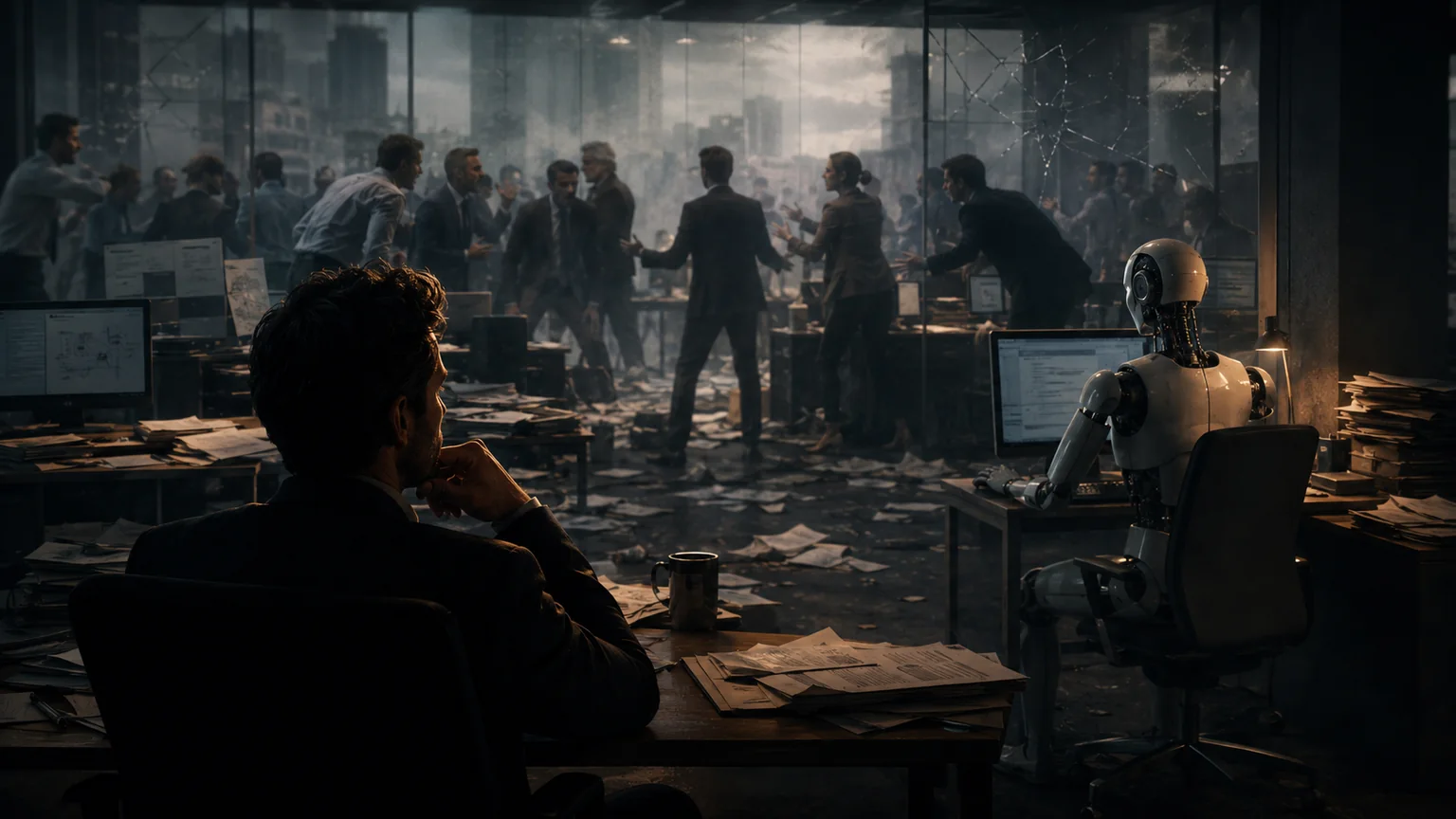
A Note for the Fire
We keep being told that AI is disrupting work, disrupting business, disrupting customer experience, disrupting leadership, disrupting everything from search bars to strategy decks. It is the favoured word of the moment, spoken with equal parts awe and dread, as though the machine arrived one morning, kicked down the front door, and introduced instability to an otherwise orderly world.
I do not think that is quite right. Or at least, not right in the most interesting way.
Much of what is being called disruption feels, on closer inspection, more like exposure. AI is not always arriving as the first cause of disorder. Very often, it is functioning more like a bright industrial lamp swung into the ceiling beams, showing just how much of the place was already being held together with workarounds, tribal memory, managerial choreography, and decorative certainty. That is what I want to place on the table tonight.
AI is not the disruption. Exposure is. The technology is not creating all the instability organisations fear. In many cases, it is simply making it harder to hide the instability that was already there.
We Prefer to Blame the Tool
There is something psychologically convenient about blaming the tool. It preserves the dignity of the old system. It lets leaders tell a story in which the organisation was functioning reasonably well until this unruly new force arrived and complicated everything. It casts AI as the troublemaker, the disturber of peace, the thing that made work messy.
But that version flatters us. A great many organisations were already messy. Their workflows were brittle. Their decision rights were vague. Their knowledge lived in people’s heads rather than in living systems. Their metrics rewarded motion more than meaning. Their functions collaborated through improvisation, goodwill, and escalation fatigue more often than they would ever admit in a transformation deck.
AI did not invent that fragility. It touched it, and it lit up.
That is part of why the gap between experimentation and real impact remains so striking. McKinsey’s 2025 state-of-AI research says organisations are beginning to rewire workflows to capture value, and that redesigning workflows has the biggest effect on whether firms actually see EBIT impact from generative AI. Its later 2025 survey also found that high performers are nearly three times as likely as others to fundamentally redesign workflows. (McKinsey & Company)
That is not the pattern you see when the tool itself is the main problem. That is the pattern you see when the tool is revealing that the old way of working was never as coherent as everyone hoped.
AI Is a Stress Test for Hidden Weakness
Every system contains assumptions it has not fully examined. About how work flows. Who knows what. Where judgement is meant to sit. About how cleanly one function hands off to another. Whether people are solving the real problem or simply passing it around in more sophisticated packaging.
For a while, many of those assumptions survive because the system is familiar with itself. People compensate. They patch. Translate. They carry invisible context from one room to another. They make an awkward machine appear smoother than it really is because human beings are often astonishingly good at keeping a fragile structure from publicly embarrassing itself.
Then AI enters the workflow.
Now the handoffs matter more. The ambiguity matters more. The undocumented decision logic. The quality of the underlying process. The role architecture matters more. The manager who never had to explain why a decision gets made in a certain sequence suddenly discovers that the sequence does not actually hold up well under scrutiny. The workflow that depended on three helpful humans quietly noticing one another’s omissions starts to look less like a process and more like a superstition with calendar invites.
That is why AI so often feels like pressure. It is a stress test. What breaks under that pressure was rarely strong to begin with.
Boston Consulting Group has been making a related point in sharper business language: most companies are experimenting with AI, but too many remain in fragmented, limited efforts that generate little lasting P&L impact. Their March 2026 analysis argues that piecemeal experimentation is one of the main barriers to impact. (BCG Global)
Which is another way of saying: the technology is not merely asking whether you have a model. It is asking whether you have a real operating system.
The Real Shock Is Organisational Self-Recognition
The most uncomfortable part of this moment is not technical. It is existential.
AI does not only force organisations to ask what the tool can do. It forces them to ask what kind of organisation they already were before the tool arrived. Were they genuinely designed to learn, or merely designed to report? Were their managers orchestrators of real work, or custodians of visibility? Did the company distribute judgement with seriousness, or praise judgement poetically while tightening every structure around it? Was the process robust, or had it simply become familiar enough that everyone mistook repetition for sound design?
This is where the conversation gets awkward.
AI is exposing not only weak workflows, but flattering stories. It is interrupting the corporate habit of confusing order with health. A team may have looked aligned because everyone had learned how not to make certain fragilities visible. A function may have looked efficient because nobody was pricing the human translation cost required to keep it moving. A manager may have looked strong because the old system never forced them to explain, clearly and structurally, how the work actually holds together.
Then the spotlight comes on. And now the organisation is left looking at itself more honestly than it wanted.
The Bubble Fantasy
This is where the “AI bubble” sentiment becomes interesting.
Not because the hype question is entirely irrelevant. There is clearly a speculative layer around AI, and parts of the market may well correct as inflated expectations meet the slower, harsher reality of enterprise change. That has happened before with technologies sold first as miracle and only later understood as infrastructure. The World Economic Forum’s recent scenario work also reflects how unsettled the future still feels, with very different plausible pathways for how AI and talent strategy could reshape firms by 2030. (World Economic Forum)
But the more revealing point is psychological. For some leaders, the hope of a bubble becomes a hope of escape. If AI turns out to be overblown, perhaps they will not have to reckon with what it has already shown them. The old structure can remain mostly intact. Perhaps this will become just another glossy wave of executive enthusiasm that eventually settles into harmless jargon and a few discontinued pilots.
That would be convenient. It would also be a fantasy. Even if some of the hype cools, the exposure does not politely reverse itself. Once a tool has shown you where the workflow is brittle, where the decision rights are muddled, where the management logic is stale, and where the knowledge architecture is a patchwork of heroic memory, choosing not to look is no longer innocence. It is leadership by wilful dimming.
The bubble may burst in some places. The spotlight does not forget what it already revealed.
The Spotlight Creates a Leadership Test
This, to me, is where the question really lives. The presence of exposure creates a choice. Leaders do not merely have to decide whether they are pro-AI or anti-AI, bold or cautious, fast or measured. They have to decide what they will do when the light hits the machinery and the machinery turns out to be more disorderly than the mythology suggested.
Some will turn away. They will call the whole thing hype, noise, distraction, a bubble, a fad. Not because they have reached a mature conclusion about the technology, but because they dislike what the technology has revealed about them.
Some will use AI as patchwork. They will layer speed over disorder and call it innovation. They will automate local tasks while preserving the old architecture. Ask the tool to modernise the surface while protecting the underlying social order, especially the parts built around managerial reassurance and control.
And some will treat the exposure as permission.
Permission to redesign workflows that were already absurd. Permission to clarify decision rights that were always muddy. To move knowledge out of heroic individuals and into better systems. To stop rewarding decorative activity and start rewarding real orchestration. Permission to build something truer because the old thing can no longer hide behind familiarity.
That is the real leadership test. Not whether you adopt AI. What you do when AI shows you the truth.
Leaders Want Efficiency. AI Demands Reinvention
This is where many transformations go thin.
Leaders often want AI to remove friction without forcing self-examination. They want efficiency gains without role redesign. Cost reduction without confronting workflow absurdity. The speed of intelligence without the discomfort of structural reinvention. They want innovation that leaves the inherited authority structure mostly untouched.
But the evidence increasingly points the other way. McKinsey’s 2025 research is blunt that the value of AI comes from rewiring how companies run, and that workflow redesign has the biggest effect on whether firms see meaningful financial impact. BCG is equally clear that fragmented efforts and under-integrated experimentation keep companies stuck in baby steps with limited gains. (McKinsey & Company)
In other words, AI keeps demanding something many organisations hoped to avoid.
Not just automation. Reinvention.
That is why so many new AI job titles still feel transitional rather than transformational. They are often attempts to help the old machine absorb a new tool without changing its deeper habits. Useful, perhaps. Necessary, perhaps. But still fundamentally conservative. The more interesting question is not what title gets created. It is what assumptions get retired.
If AI is really going to create value, it cannot remain a layer laid over inherited incoherence. It has to force better questions about the design of work itself.
The Middle Manager Moment Gets Awkward
There is another exposure here, and it is delicate enough that many organisations still prefer not to name it directly. AI is exposing not only weak processes, but weak management.
Not all management, of course. But enough of it.
Where work was once coordinated through proximity, repetition, and informal authority, AI begins to demand sharper clarity. Why is this step here? Why does this decision sit with this person? Why is knowledge routed through that gatekeeper? Why does this team need three approvals for something another team resolves in one judgement call? Why is the manager adding value here, exactly? Through orchestration, coaching, and design? Or simply through friction, oversight theatre, and inherited gatekeeping?
McKinsey’s 2025 workplace report argues that employee readiness for AI is higher than many leaders assume, and that leaders therefore have the permission space to be bolder. That is a subtle but important point. It suggests the larger hesitation is not coming mainly from the workforce. It is coming from leadership structures that are less ready to redesign themselves than they are to ask employees to adapt. (McKinsey & Company)
That is where the middle of the organisation gets awkward. AI does not only threaten jobs in the shallow sensationalist sense people like to dramatise. It threatens managerial vagueness. It threatens roles that were never forced to become fully legible because the old world tolerated a great deal of blurred value.
Now the light is brighter. And some positions look thinner than their titles suggested.
What Better Organisations Will Do Differently
The organisations that use this moment well will not be the ones that merely ask, “How do we insert AI into the current shape?” They will ask a harder and more creative question:
What current shape has AI just shown to be absurd?
They will look at workflows as living design, not inherited furniture. They will take seriously the fact that most of AI’s value sits in core business processes where decisions, cost, and outcomes intersect, rather than in peripheral novelty. They will redesign roles around judgement, orchestration, and human-machine collaboration rather than bolting tools onto old job descriptions and hoping culture catches up later. (BCG Global)
They will also recognise that this is not only a technology programme. It is a philosophy test.
Do you believe people closest to the work can help redesign it? Do you trust your managers to become orchestrators rather than bottlenecks? Do you believe a process can be challenged without the challenge becoming political contamination? Can you let the light stay on long enough to see what the tool is actually telling you about the business?
That is where better organisations will separate themselves. Not in how loudly they talk about AI, but in how honestly they respond to exposure.
A Better Question for the Fire
So this is the thought I want to leave by the fire tonight.
AI is not the disruption. Exposure is.
The technology is not creating all the disorder organisations fear. Much of that disorder was already there, quietly managed, disguised neatly, or measured incorrectly. What AI is doing is making the old incoherence harder to hide and the old managerial stories harder to sustain. It is functioning less like a villain and more like a floodlight.
And once the light is on, a choice appears.
You can dim it, patch the old machine, and hope the hype cycle gives you cover. Or you can treat the discomfort as information and become part of the disruption that builds something better, truer, and more equal to the conditions now in front of you.
So from your side of the work, here is the question I want to leave on the table:
When AI exposed the disorder in your world, did leadership treat it as a threat to be managed, a gimmick to wait out, or an invitation to build something truer?